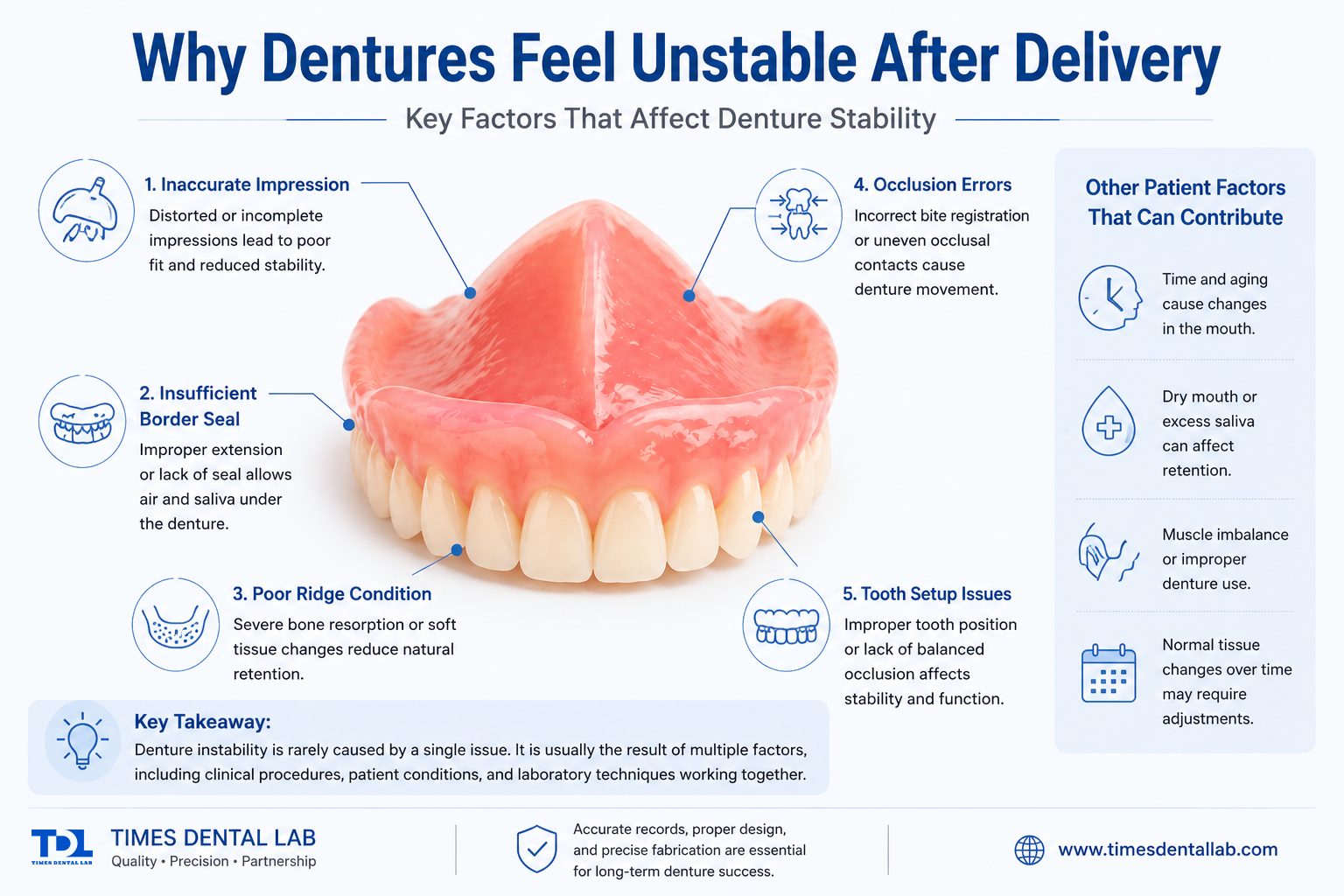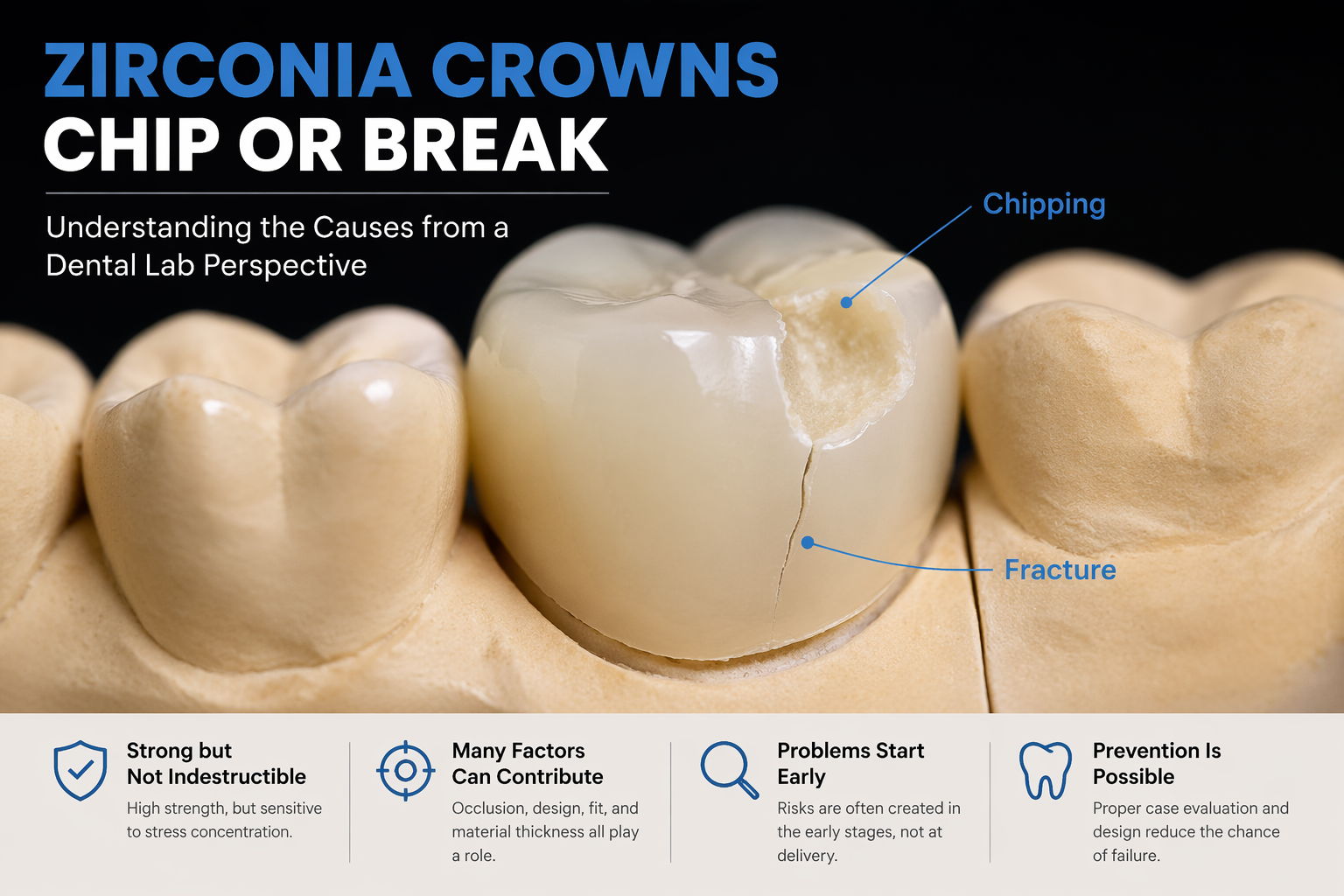
義歯の試用: 最終納品までに複数回の試用が必要な場合がある理由
義歯の試用は、取り外し可能な補綴物の日常的な手順としてよく見られます。簡単な場合には、最終加工前に審美性、噛み合わせ、歯の位置を確認するには 1 回の試用で十分な場合があります。しかし、実際のリムーバブル ワークフローでは、すべてのケースが予測どおりに動作するわけではありません。
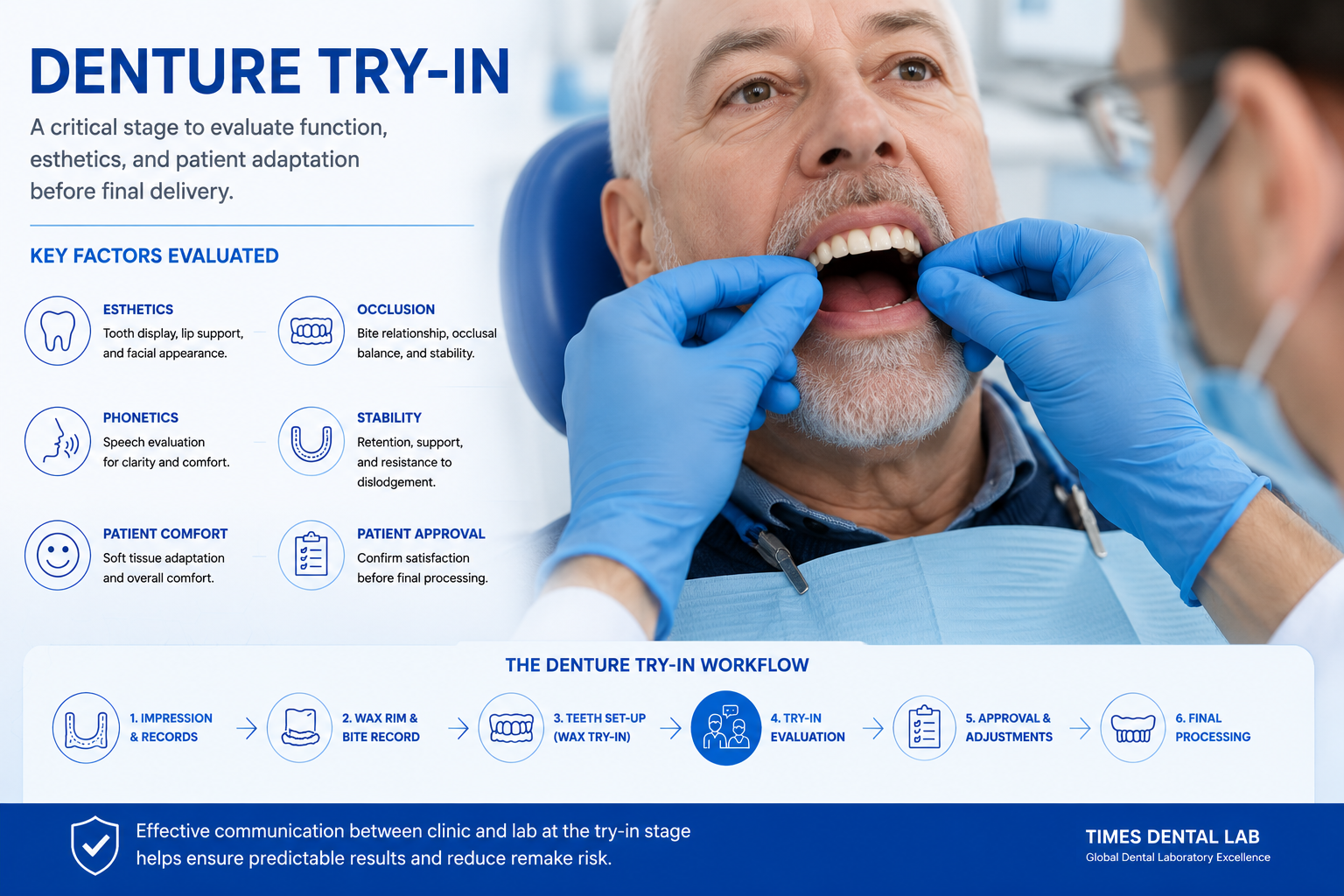
Times Dental Lab では、最初の試用では咬合器上は問題ないように見えても、最終納品前に追加の検証が必要な義歯の症例を数多く見てきました。時には、機能中に咬合関係が変化することがあります。場合によっては、患者が提案された歯の位置に適応できない場合があります。舌が自然に機能し始めると、下の義歯が不安定になることがあります。また、写真では審美性が正しく見えても、患者が自然に話したり笑顔になったりすると、違ったものに感じられる場合もあります。
これが、経験豊富な取り外し可能な技術者が義歯の試用を単純な手順として扱わない理由です。トライインは多くの場合、リメイクされる前に隠れた問題が現れ始める段階です。
取り外し可能な補綴物では、追加の試用は必ずしも何か問題が発生したことを示すものではありません。多くの困難なケースでは、これは慎重なリスク管理の一環です。
義歯の試用とは何ですか?なぜ重要ですか?
義歯の試用は、最終処理の前に義歯のセットアップを評価する段階です。通常、歯はワックスで配置されているため、クリニック、患者、研究室はアクリル処理の前にケースを確認できます。
この段階では以下の検証が可能です:
lllバイト関係
lllllスマイルライン
l患者の承認
単純な取り外し可能なケースでは、試着は主に確認ステップとして機能する場合があります。しかし、より困難なケースでは、試用が重要な診断段階になります。
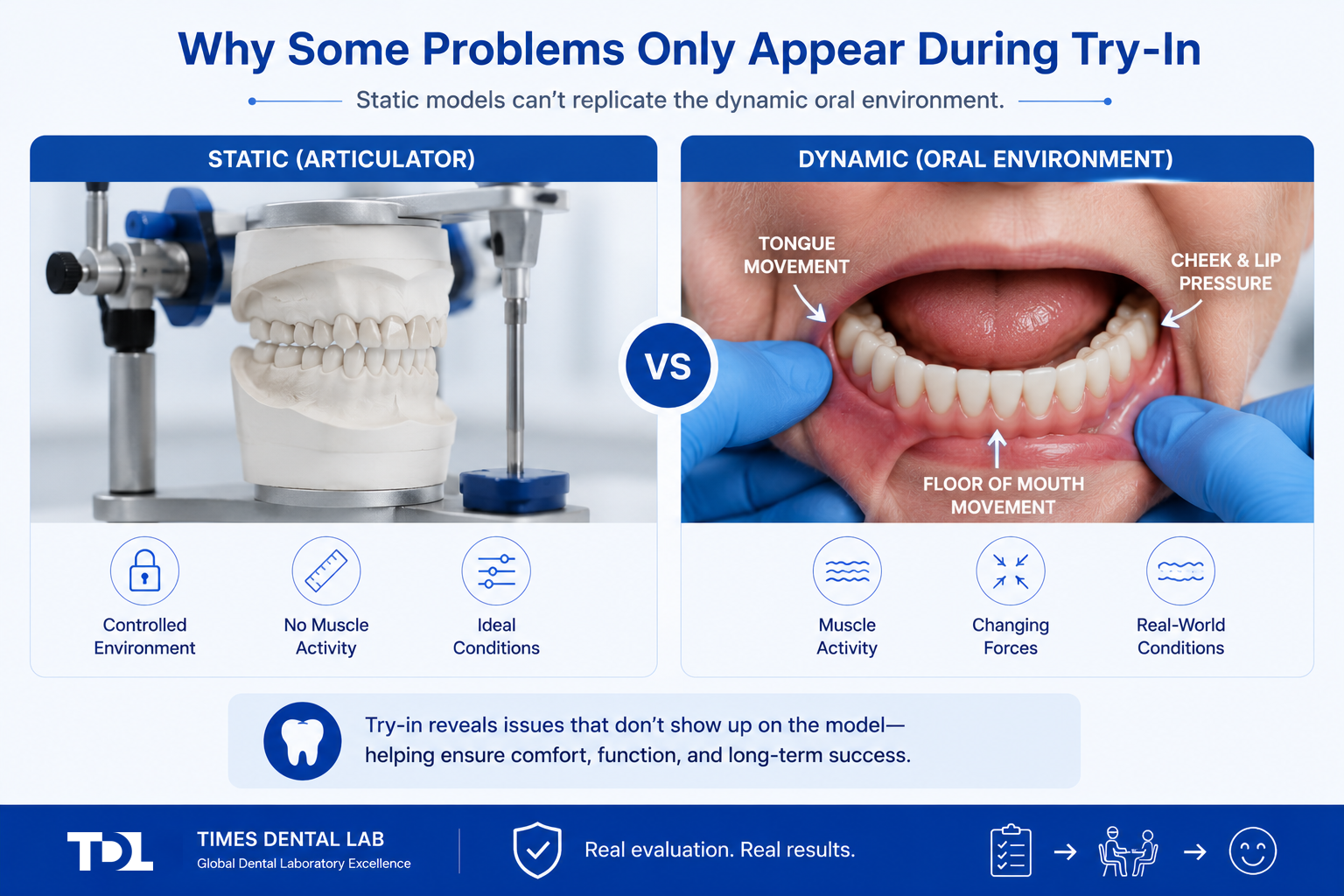
ラボの観点から見ると、多くの場合、セットアップが静的ではなく動的に評価されるのはこれが初めてです。咬合器は動きをある程度シミュレートできますが、舌の動作、嚥下パターン、頬の圧力、顔の表情、患者の適応を完全に再現することはできません。
多くの取り外し可能な技術者の多くが、試用段階が義歯のワークフローの最も重要な部分の 1 つであると考えているのはそのためです。
急いでトライインすると一時的に時間を節約できる可能性がありますが、この段階で未解決の問題は最終処理後にさらに大きくなることがよくあります。
通常は 1 回の試着で十分な場合
すべての義歯ケースで複数回の試用が必要なわけではありません。一部のケースは比較的予測可能です。
通常、次の場合は 1 回の試用で十分である可能性が高くなります。
lリッジの構造は安定しています。
lバイト登録はクリアです。
l患者は以前に義歯を正常に装着しました。
l以前の義歯は信頼性の高い基準を提供します。
l美的期待は単純です。
lジョーリレーションレコードは一貫しています。
l試用中に下の義歯は適度な安定性を示します。
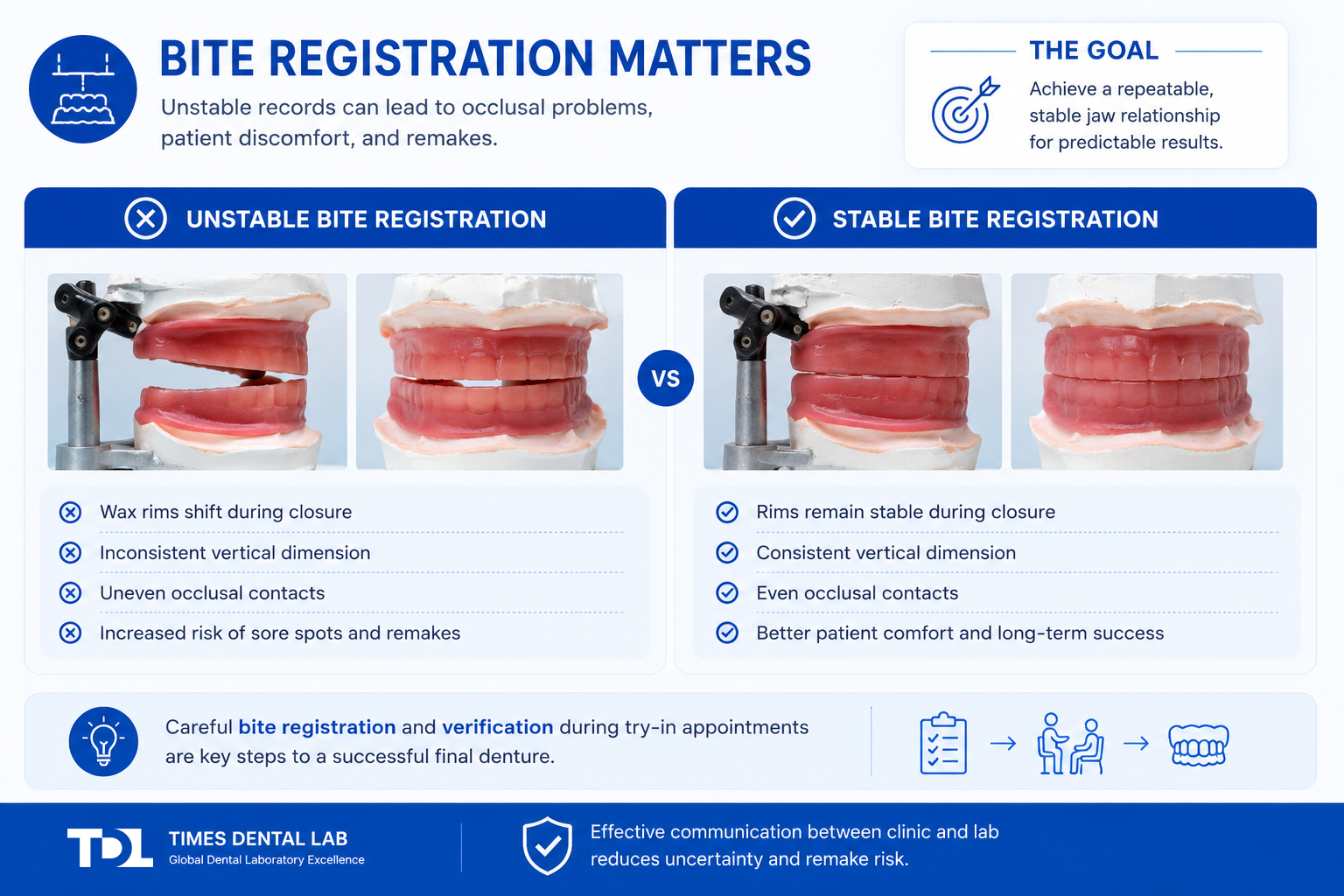
これらのケースは、変数が少ないため、より予測どおりに動作する傾向があります。 たとえば、上下の隆起部が安定し、咬合関係が明確で、既存の義歯が良好に機能している患者は、新しいセットアップにより簡単に適応できることがよくあります。このような状況では、試着では不確実性を解決するのではなく、主に詳細を確認します。 ただし、経験豊富なラボは依然としてこれらの症例を注意深く検討しています。試用中に重要な詳細が無視されると、予測可能なケースでも問題が発生する可能性があります。 一部の取り外し可能なケースには、最初から不確実性が含まれています。追加のトライインは、多くの場合、不適切なワークフローによって引き起こされるわけではありません。これは、ケース自体の複雑さが原因です。 何度も義歯を試してみる最も一般的な理由の 1 つは、咬合位置が不安定であることです。 総義歯の場合、特に下の義歯の場合、顎関係の記録を一貫して再現するのは必ずしも容易ではありません。ワックスリムがずれる場合があります。個別の予約では、患者の受付が異なる場合があります。筋肉の緊張は閉鎖に影響を与える可能性があります。垂直方向の寸法は不確実なままである可能性があります。 これは、次のような患者に特によく見られます。 l何年もの間、不安定な入れ歯を使用しています。
l深刻なリッジ吸収があります。
l後方サポートが失われています。
l一貫性のないクロージャパターンを表示します。
l顎の位置を一貫して繰り返すのに苦労します。
ある診察では噛み合わせが許容範囲内に見えても、別の診察では変化することがあります。咬合器はまだ安定しているように見えますが、口腔内の機能に矛盾があることがわかります。 経験豊富なリムーバブル技術者は通常、次の場合に慎重になります。 lバイト関係は繰り返し変化します。
l閉じるときにワックスのリムが移動します。
l毎回異なる方法で閉じます。
l下の縁が安定していません。
l 試行中にセットアップが不安定になる このような状況では、義歯の加工が早すぎると、再製作のリスクが大幅に高まる可能性があります。 顎の関係が本当に再現可能かどうかを確認するために、追加の試行が必要になる場合があります。 重度の隆起吸収は、取り外し可能な補綴物のほぼすべての側面を変化させます。 下顎堤が平らになったり、狭くなったり、ひどく吸収されたりすると、義歯の安定性を予測することが非常に困難になります。咬合器上でセットアップが許容できるように見えても、機能中に下の義歯が動く可能性があります。 次の場合: lワックスリムが不安定になる可能性があります。
lバイト登録が変わる可能性があります。
l 話している間に設定が傾く可能性があります l咬合圧が均一に分散されにくくなります。
l義歯の保持力がさらに制限されます。
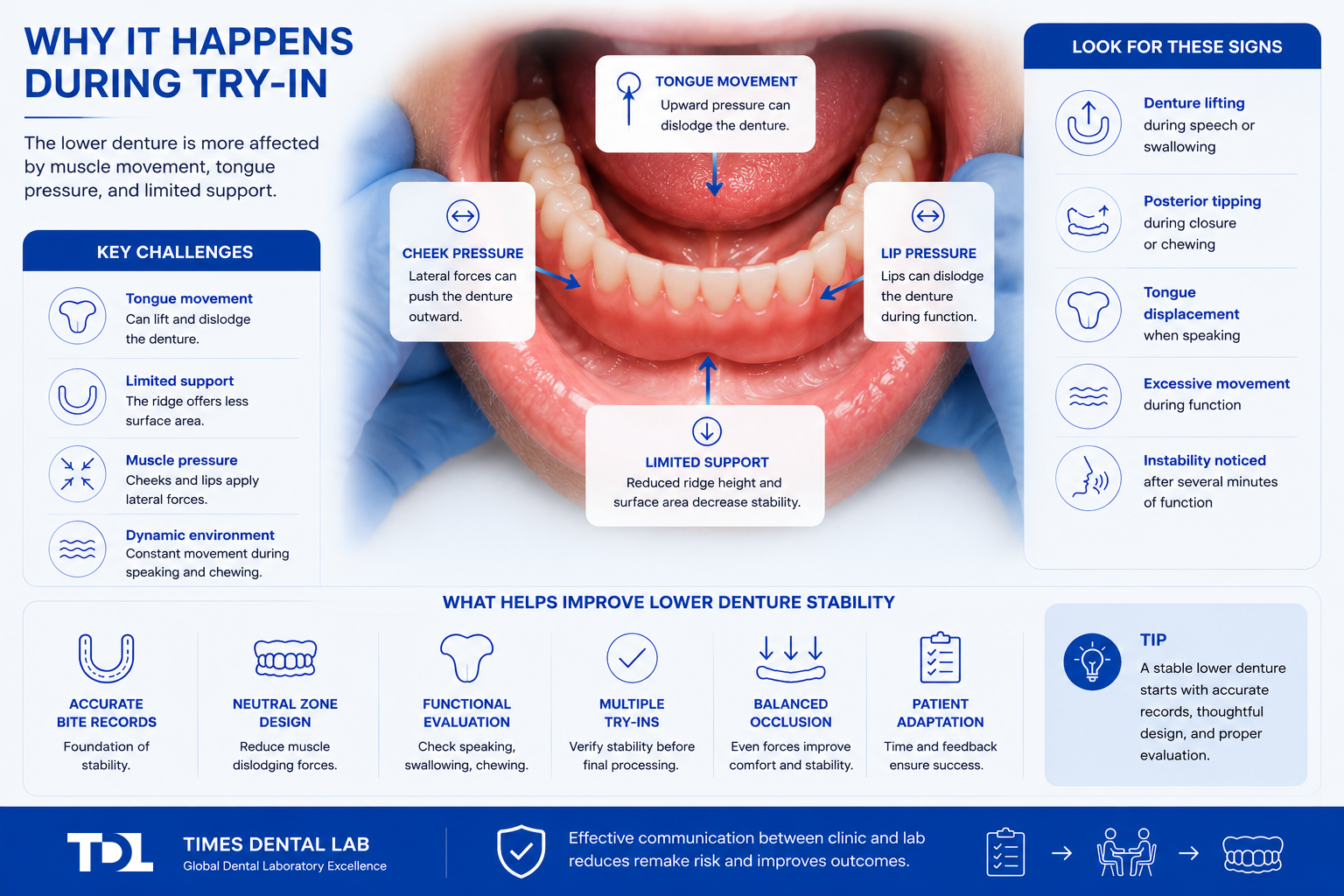
これが、進行した下顎骨吸収の患者が最終処理の前にさらなる検証を必要とすることが多い理由です。 Times Dental Lab では、患者が自然に機能し始めると、隆起部のサポートが限られている下の義歯の動作が異なる可能性があることによく気づきます。セットアップは、短時間の試用の予定では許容できるように見えますが、咀嚼中や会話中に不安定になる場合があります。 これが、経験豊富なラボが、すぐに処理を急ぐのではなく、別の試用を推奨する場合がある理由の 1 つです。 下顎義歯の不安定性は、取り外し可能な補綴物の最も困難な部分の 1 つです。 上義歯は、より広い口蓋サポートとより安定した環境から恩恵を受けます。下顎義歯は、よりダイナミックな空間に存在します。舌は常に動いています。頬に圧力がかかります。口底は、嚥下中および発話中に位置が変わります。 これは、適切に作られた下部セットアップであっても、患者が自然に機能し始めると、異なる動作をする可能性があることを意味します。 場合によっては、下部のトライインに次のメッセージが表示されることがあります。 l発話中の義歯の持ち上げ
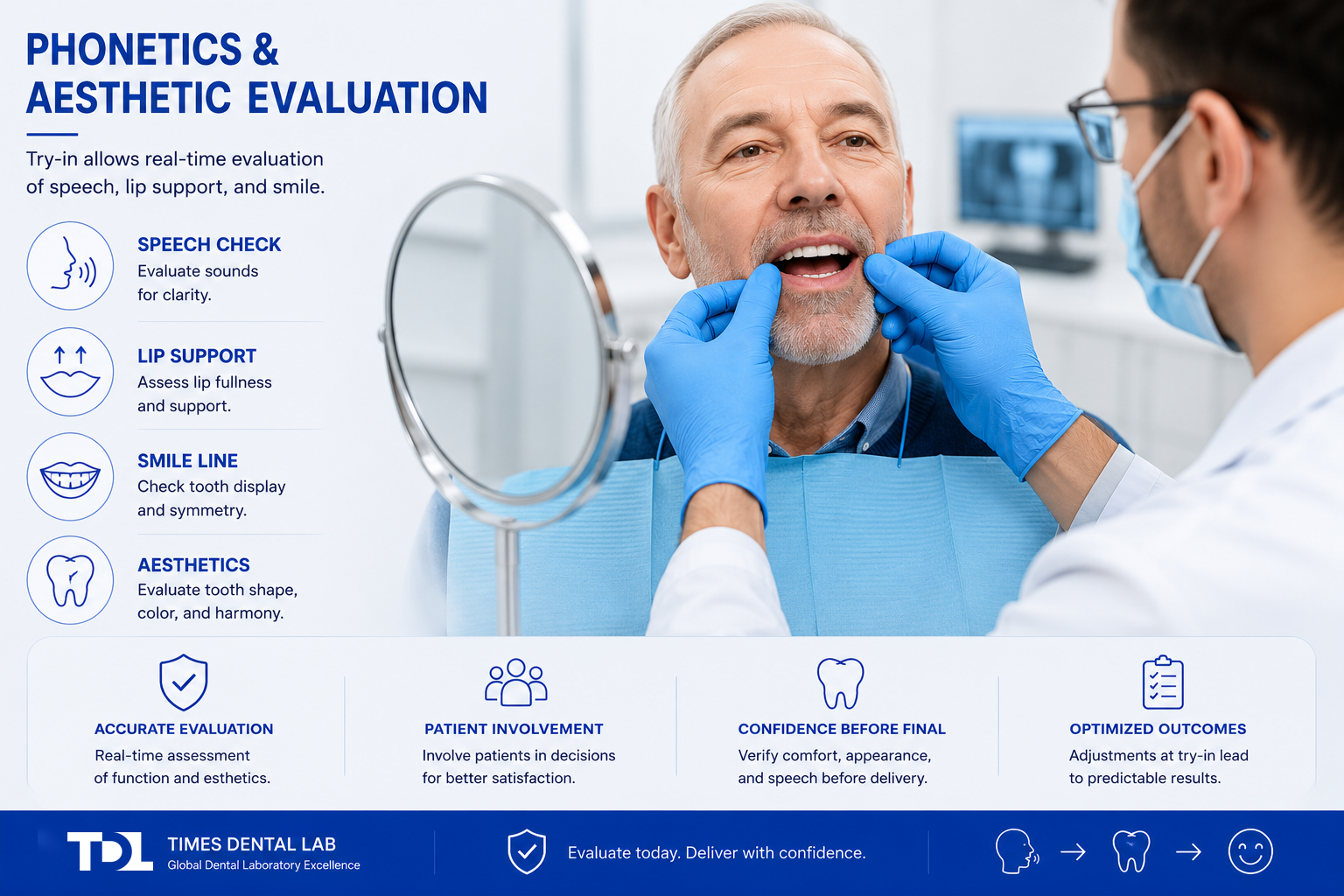
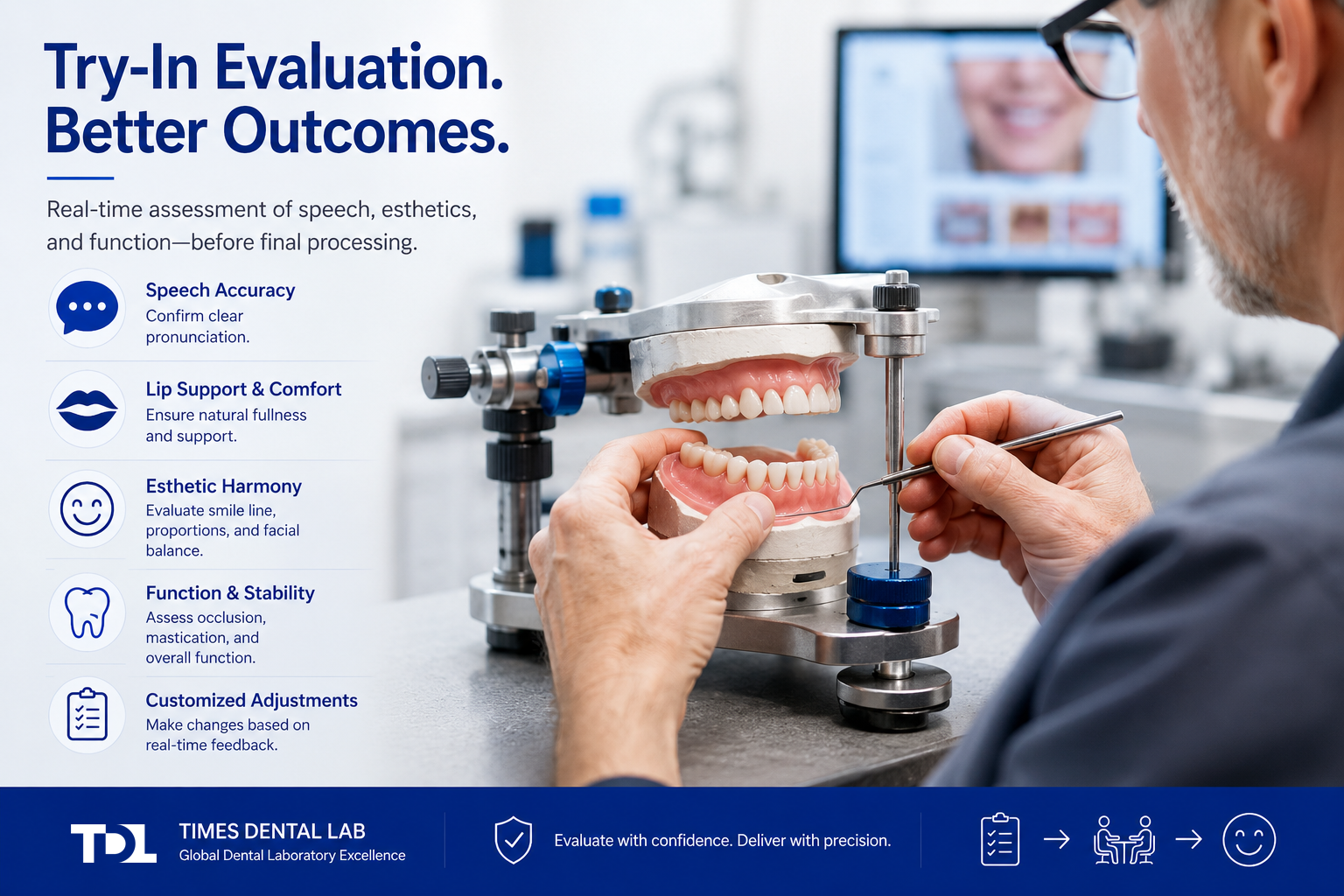
ll不安定な咀嚼パターン l後部ティッピング l 飲み込み中の過剰な動き これらの問題は、必ずしもすぐに明らかになるわけではありません。場合によっては、患者が数分間話した後に初めて不安定さに気づく場合もあります。 これが、下顎義歯の試用を静的にのみ評価すべきではない理由です。 経験豊富な取り外し可能な技術者が、模型上でどのように見えるかだけでなく、移動中に義歯がどのように動作するかを観察します。 審美性への懸念も、複数回の試着を行う一般的な理由です。 義歯は技術的にはうまく適合する可能性がありますが、患者は次の点について不確かであるため、調整が必要です。 llllスマイルライン ll midline position l facial profile This is especially common when the new denture differs significantly from the previous denture. Long-term denture wearers often adapt psychologically and muscularly to their old setup, even if it was technically incorrect. A corrected setup may initially feel “wrong” simply because it is unfamiliar. Sometimes patients request changes only after seeing themselves speaking or smiling naturally. Static photos may not reveal the full esthetic effect. Experienced labs understand that esthetics cannot always be finalized entirely on the articulator. Some adjustments become obvious only during real facial movement. Speech evaluation is one of the most underestimated parts of denture try-ins. Tooth position, vertical dimension, incisal edge position, and palatal contour can all affect phonetics. Patients may struggle with: l S sounds l F sounds l V sounds l tongue positioning l air escape during speech Sometimes these problems appear only after the patient speaks naturally for several minutes. A setup may look esthetically correct but still interfere with speech because: l anterior teeth are positioned incorrectly l the vertical dimension is excessive l the palatal contour affects tongue placement l the lower denture lacks stability during speaking This is another reason why some cases require additional try-ins before final processing. Once acrylic processing is completed, correcting major phonetic issues becomes much more difficult. Large changes from the previous denture often increase uncertainty. This includes: l changing vertical dimension l changing tooth position l correcting collapsed bite l altering facial support l changing occlusal scheme l improving lower denture stability Even when these changes are technically beneficial, patients may need time to adapt. At Times Dental Lab, we often see cases where the old denture had been worn for many years despite poor function. The patient’s muscles adapted to that condition. When a new setup attempts to correct the bite or improve support, the patient may initially feel uncomfortable. In these situations, additional try-ins can help confirm whether the patient is adapting gradually or whether major adjustments are still needed before processing. Experienced removable technicians do not recommend additional try-ins casually. In most cases, the goal is not to slow production. The goal is to reduce uncertainty before final processing. A second try-in is often recommended when: l the bite relationship appears inconsistent l lower denture stability is questionable l esthetic approval remains uncertain l speech problems appear during evaluation l tooth position may still require refinement l the patient cannot adapt comfortably during try-in l the ridge anatomy creates high instability risk This approach is based on long-term predictability. A denture that requires one extra try-in may still save weeks of remake adjustments later. From a removable perspective, processing a questionable setup too early usually increases overall chair time instead of reducing it. The articulator provides a controlled environment. The mouth does not. This difference explains why some denture problems only become obvious during try-in. During function, the patient introduces variables that cannot be fully simulated on the bench: l swallowing l speech l facial expression l cheek pressure l saliva condition l neuromuscular control A setup that appears stable on the model may become unstable once these forces begin interacting with the denture. This is especially true for lower dentures. At Times Dental Lab, we often explain that the try-in stage is where the denture first enters a dynamic environment. The technician can design carefully, but the real functional behavior only becomes visible once the patient starts using the setup naturally. That is why experienced labs observe not only appearance, but also movement. One of the most common removable workflow mistakes is processing the denture before uncertainty is resolved. This often happens when: l delivery deadlines are tight l the patient wants fast completion l the try-in appears “good enough” l small concerns are ignored temporarily However, unresolved issues tend to become harder to correct after processing. For example: l unstable occlusion may create soreness l unresolved esthetic concerns may lead to dissatisfaction l lower denture instability may worsen after acrylic processing l phonetic problems may become more obvious l processing distortion may slightly alter the bite relationship At that stage, adjustment becomes more limited. This is why experienced removable workflows prioritize predictability instead of speed alone. Additional try-ins can significantly reduce remake risk in complex cases. They allow further verification of: l bite consistency l tooth positioning l speech l esthetics l lower denture behavior l patient adaptation l jaw relation stability This is especially important in removable prosthetics because many problems are cumulative. A small occlusal discrepancy combined with lower denture instability and patient adaptation difficulty can quickly become a major complaint after delivery. From a lab perspective, multiple try-ins are often part of preventive workflow rather than corrective workflow. It is usually easier to adjust wax than to remake processed acrylic. Lower dentures are less forgiving than upper dentures. Small discrepancies become more noticeable because the lower denture has: l less support area l no palatal suction l greater tongue interaction l higher muscle interference l more sensitivity to occlusal imbalance Even slight occlusal changes can destabilize a lower denture during chewing. This is why lower removable cases often require additional verification before final processing. At Times Dental Lab, we usually evaluate lower denture try-ins carefully for: l lifting during speech l posterior tipping l tongue displacement l unstable bite closure l unsupported occlusal force l excessive movement during swallowing These details may appear minor during try-in but become much more significant after delivery. Digital dentures have improved removable workflows in many ways. Digital systems help with: l repeatability l data storage l CAD modification l workflow consistency l communication efficiency But digital technology does not eliminate every removable variable. A scan captures anatomy at one moment. It does not fully capture dynamic muscle behavior, patient adaptation, or functional movement. Even highly accurate digital setups still depend on: l stable clinical records l correct jaw relation l functional tooth positioning l patient adaptation l removable experience This is why digital dentures may still require additional try-ins in difficult cases. Technology improves consistency, but it does not completely replace clinical and technical judgment. Experienced removable technicians often notice warning signs before a denture fails. During try-in evaluation, they may watch for: l unstable wax rims l inconsistent closure l lower denture lifting l excessive tongue interference l unsupported posterior setup l shifting jaw relation l unclear speech l overclosed facial appearance l patient hesitation during approval l unstable lower denture movement during chewing simulation These observations are not always dramatic. Sometimes they appear as small inconsistencies. But removable prosthetics often depend on small details. The difference between a stable denture and a problematic denture may come from a slight occlusal discrepancy or a minor positioning issue that becomes amplified during function. At Times Dental Lab, difficult removable cases are approached with a process-based mindset rather than a purely production-based mindset. For complex denture try-ins, our removable team focuses on: l reviewing bite consistency l evaluating lower denture stability l checking tooth positioning carefully l reviewing esthetics dynamically l monitoring occlusal balance l identifying high-risk instability factors l communicating with the clinic before processing questionable setups We believe that additional verification is often preferable to avoidable remakes. Not every difficult case can be made perfectly predictable. But many common denture problems can be reduced when uncertainty is recognized early instead of ignored. For us, removable prosthetics is not only about processing dentures. It is about understanding how the denture will behave after delivery. Some denture cases involve unstable bite registration, lower denture instability, esthetic uncertainty, speech problems, or severe ridge resorption. Additional try-ins help verify these issues before final processing. Yes. In difficult removable cases, multiple try-ins are often part of careful risk control rather than a sign of failure. Yes. Skipping necessary try-ins may allow unresolved occlusion, esthetic, or stability issues to continue into final processing. Lower dentures are more affected by tongue movement, muscle pressure, and limited support area. Small errors tend to become more noticeable during function. Acrylic processing, occlusal changes, muscle adaptation, and functional movement can all affect how the denture feels after delivery. Yes. Digital workflows improve consistency, but difficult removable cases may still require try-ins to verify function, speech, esthetics, and stability. Not every denture case can be finalized safely after a single try-in. In removable prosthetics, additional try-ins are often part of careful evaluation rather than inefficiency. Complex bite relationships, lower denture instability, ridge resorption, esthetic uncertainty, phonetics, and patient adaptation can all affect the final outcome. Experienced removable workflows focus on identifying uncertainty before final processing instead of correcting preventable problems after delivery. At Times Dental Lab, we believe the try-in stage is one of the most important parts of removable treatment. It is where the denture moves from a static setup on the bench into a real functional environment. The more carefully this stage is evaluated, the more predictable the final result usually becomes.
一部の義歯ケースで複数回の試用が必要な理由
咬合位置が不安定
重度の歯槽堤吸収
試用中の義歯の不安定性を軽減
美的不確実性
Phonetics and Speech Problems
Major Changes From the Old Denture
Why Experienced Labs Sometimes Recommend Another Try-In
Why Some Problems Only Appear During Try-In
Why Rushing Final Processing Can Increase Remake Risk
How Multiple Try-Ins Help Reduce Denture Remakes
Why Lower Denture Cases Often Require More Verification
Why Digital Dentures Still Cannot Eliminate Every Try-In
What Experienced Labs Usually Watch for During Denture Try-Ins
How Times Dental Lab Handles Complex Denture Try-In Cases
FAQ
Why do some dentures need more than one try-in?
Are multiple denture try-ins normal?
Can skipping try-ins increase remake risk?
Why do lower dentures often require more adjustments?
Why can dentures feel different after final processing?
Do digital dentures still require try-ins?
Conclusion