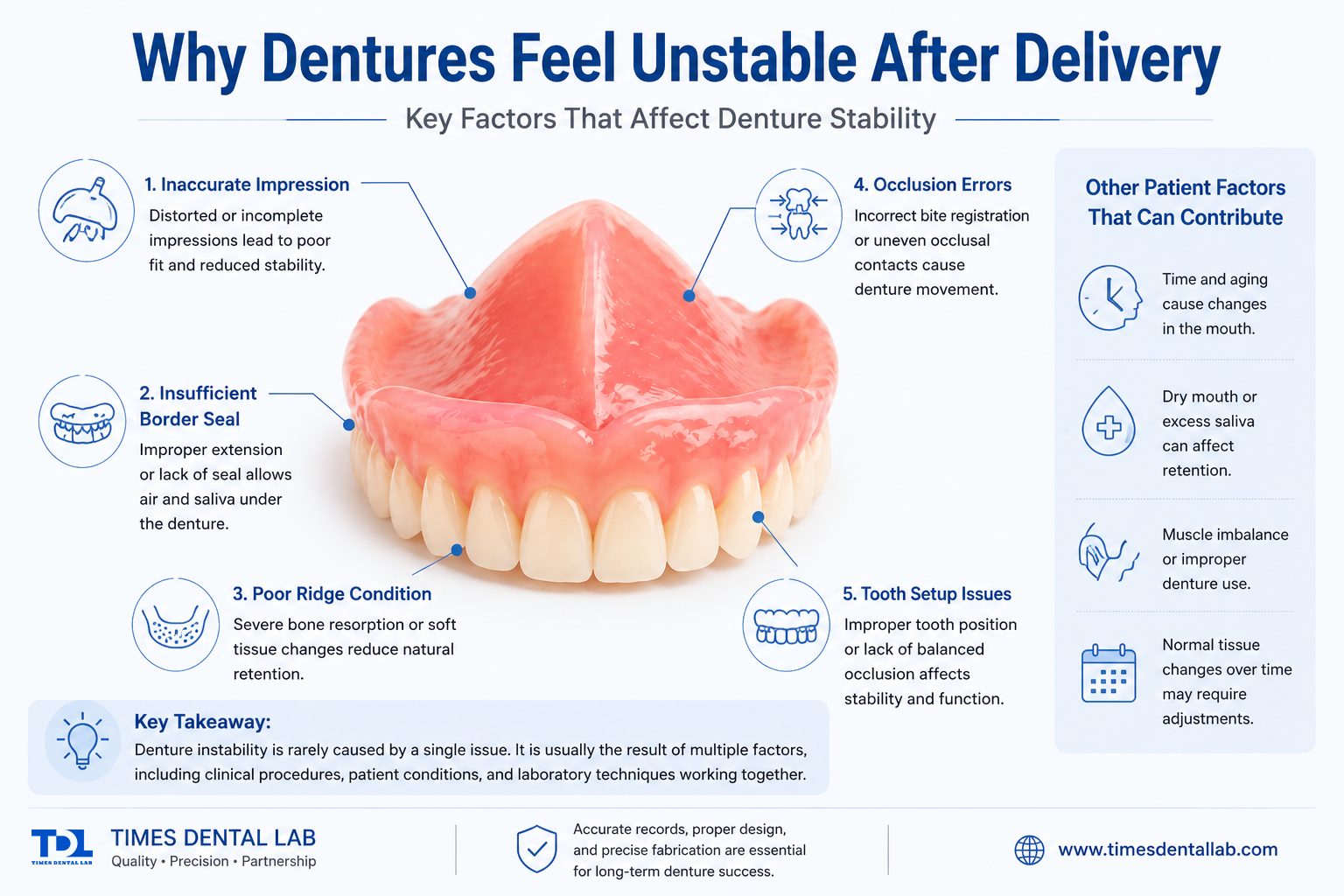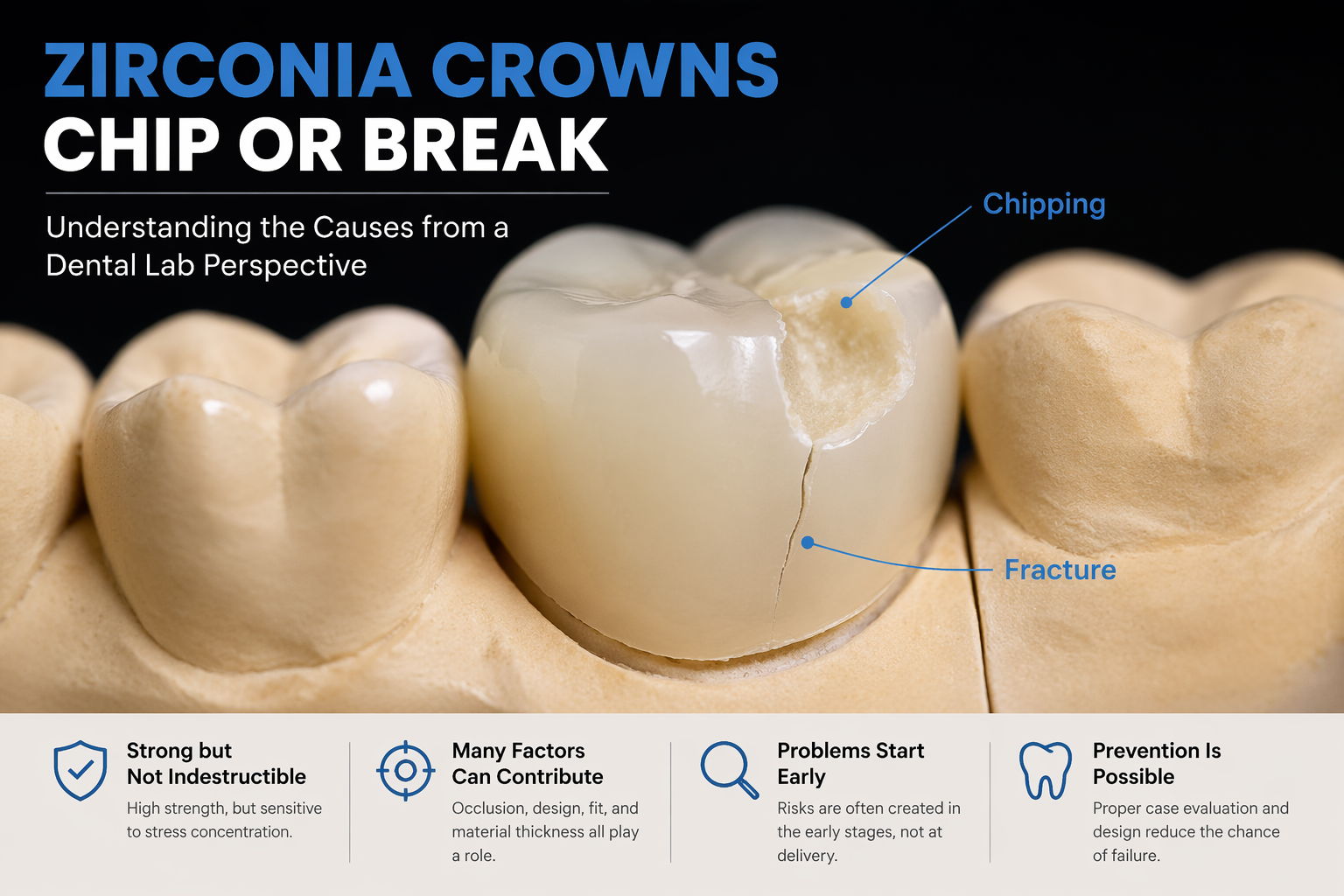
의치 시적: 최종 배송 전에 여러 번 시적해야 하는 이유
의치 시적은 종종 가철성 보철물의 일상적인 단계로 간주됩니다. 간단한 경우에는 최종 가공 전 심미성, 교합, 치아 위치를 확인하는 데 한 번의 시적만으로 충분할 수 있습니다. 그러나 실제 제거 가능한 워크플로에서는 모든 경우가 예상대로 작동하는 것은 아닙니다.
Times Dental Lab에서는 교합기에서는 첫 번째 시착이 허용되는 것처럼 보였지만 최종 배송 전에 여전히 추가 확인이 필요한 의치 사례를 많이 보았습니다. 때때로 기능 중에 교합 관계가 변경됩니다. 때때로 환자는 제안된 치아 위치에 적응할 수 없습니다. 때때로 혀가 자연스럽게 기능하기 시작하면 하부 틀니가 불안정해지는 경우도 있습니다. 다른 경우에는 사진에서는 미적인 부분이 정확해 보이지만 환자가 자연스럽게 말하거나 웃기 시작하면 다르게 느껴질 수도 있습니다.
이것이 숙련된 가철성 기공사가 의치 시적을 단순한 절차 단계로 다루지 않는 이유입니다. 트라이인은 리메이크되기 전에 숨겨진 문제가 나타나기 시작하는 단계인 경우가 많습니다.
가철성 보철물에서 추가 시운전이 항상 문제가 발생했다는 신호는 아닙니다. 많은 어려운 경우에는 신중한 위험 관리의 일환입니다.
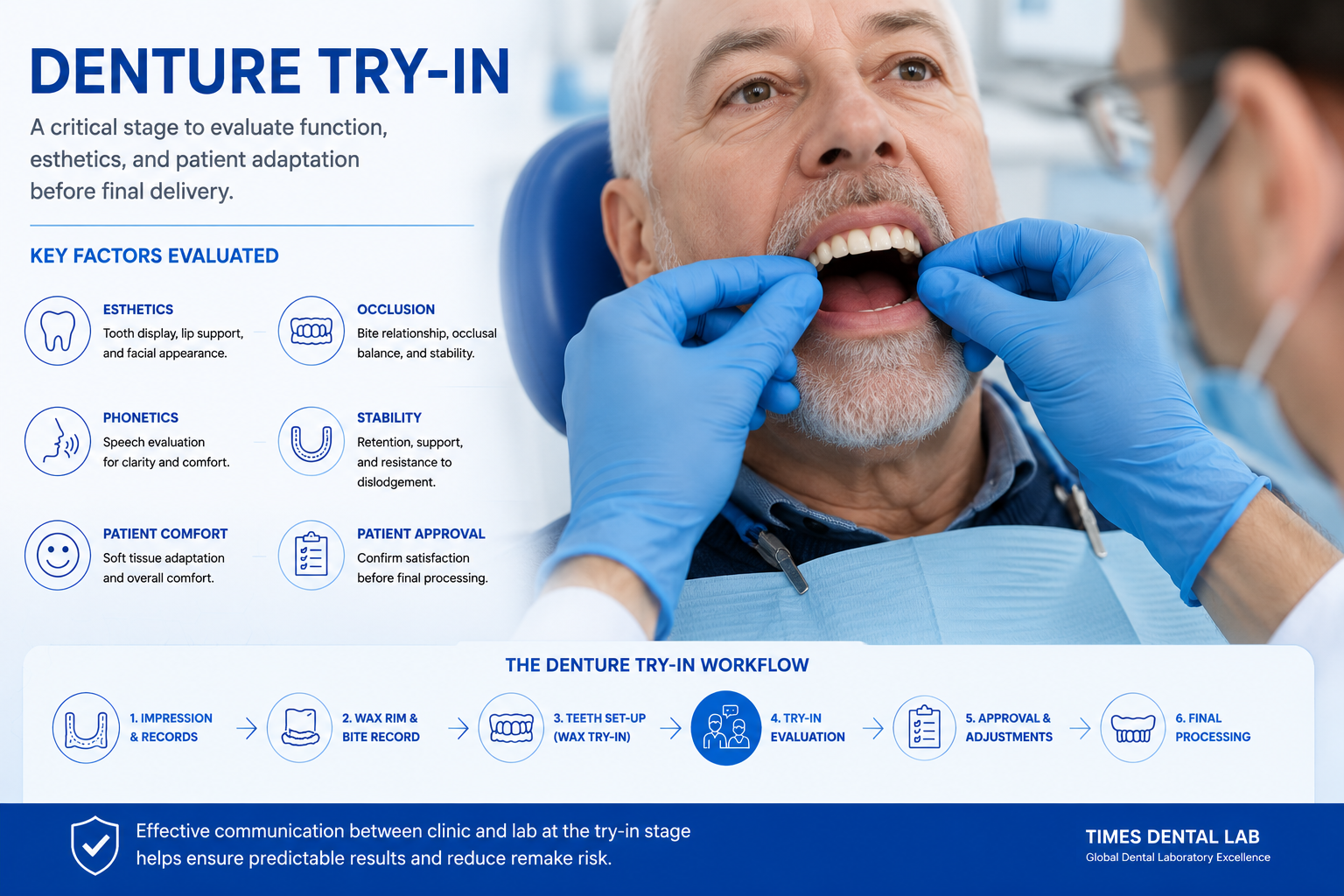
의치 시적이란 무엇이며 왜 중요한가요?
의치 시적은 최종 처리 전에 의치 설정을 평가하는 단계입니다. 치아는 일반적으로 왁스로 배열되어 아크릴 가공 전에 진료소, 환자 및 기공소에서 사례를 검토할 수 있습니다.
이 단계에서는 다음을 확인할 수 있습니다.
l 미학
l 세로 크기
l 물린 관계
l 음성학
l 치아 위치
l 교합 균형 l 립 지원
l 스마일 라인
l 환자 승인
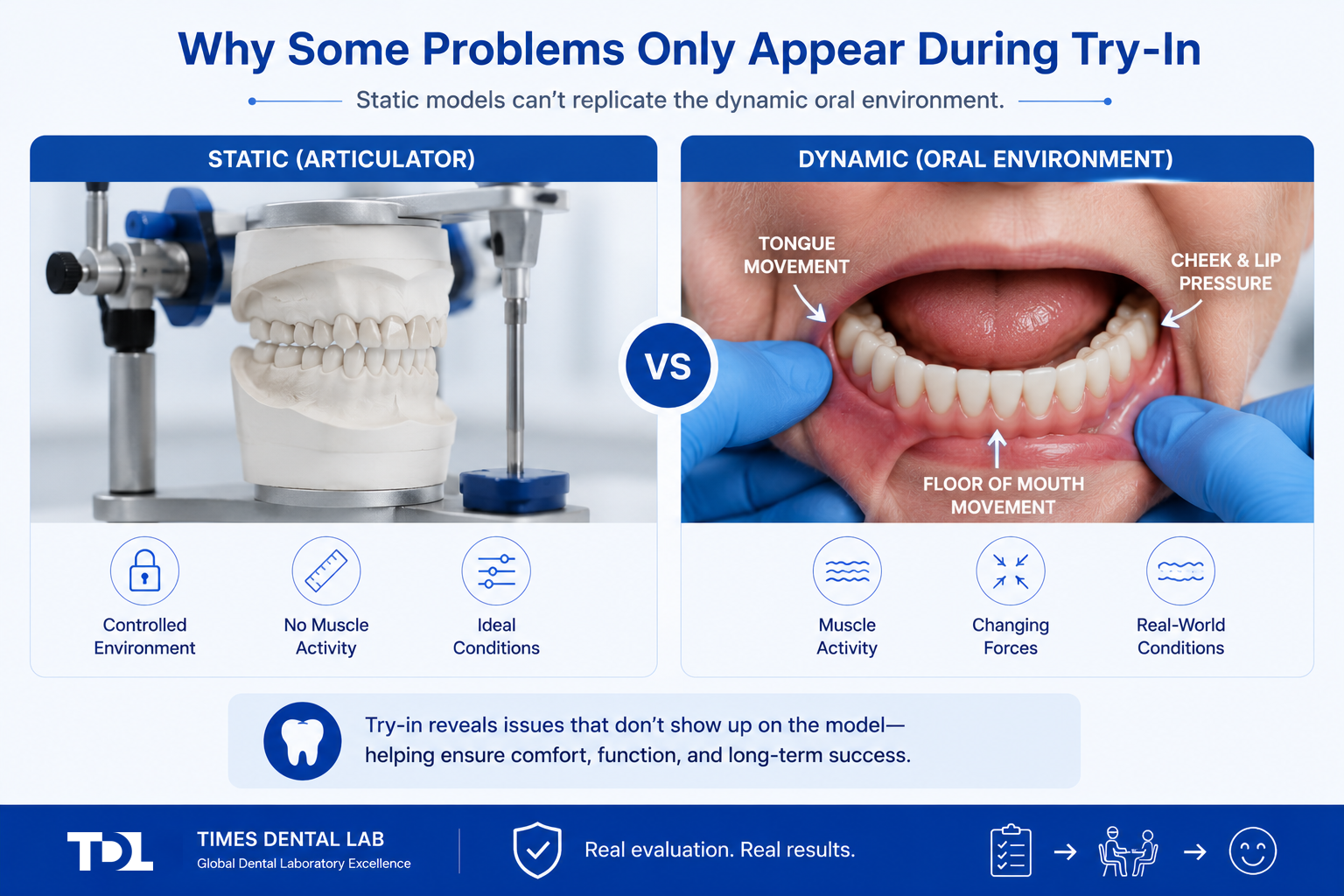
간단한 착탈식 케이스의 경우 시착이 주로 확인 단계 역할을 할 수 있습니다. 하지만 더 어려운 경우에는 시운전이 중요한 진단 단계가 됩니다. 실험실 관점에서 볼 때 설정이 정적으로 평가되는 것이 아니라 동적으로 평가되는 것은 이번이 처음인 경우가 많습니다. 교합기는 어느 정도 움직임을 시뮬레이션할 수 있지만 혀 동작, 삼키는 패턴, 볼 압력, 얼굴 표정 또는 환자 적응을 완전히 재현할 수는 없습니다. 이것이 바로 많은 가철성 기공사가 시적 단계를 의치 작업 흐름에서 가장 중요한 부분 중 하나로 간주하는 이유입니다. 급하게 시도하면 일시적으로 시간을 절약할 수 있지만, 이 단계에서 해결되지 않은 문제는 최종 처리 후에 훨씬 더 커지는 경우가 많습니다. 모든 의치 케이스에 여러 번의 시착이 필요한 것은 아닙니다. 일부 사례는 상대적으로 예측 가능합니다. 일반적으로 다음과 같은 경우에는 한 번의 시도로 충분할 가능성이 높습니다. l 능선 구조가 안정적입니다.
l 바이트 등록이 지워졌습니다.
l 이전에 환자가 의치를 성공적으로 착용했습니다.
l 신뢰할 수 있는 참조를 제공합니다 l 심미적 기대는 간단합니다.
l 턱 관계 기록은 일관됩니다.
l 시적 중에 합리적인 안정성을 보여줍니다.
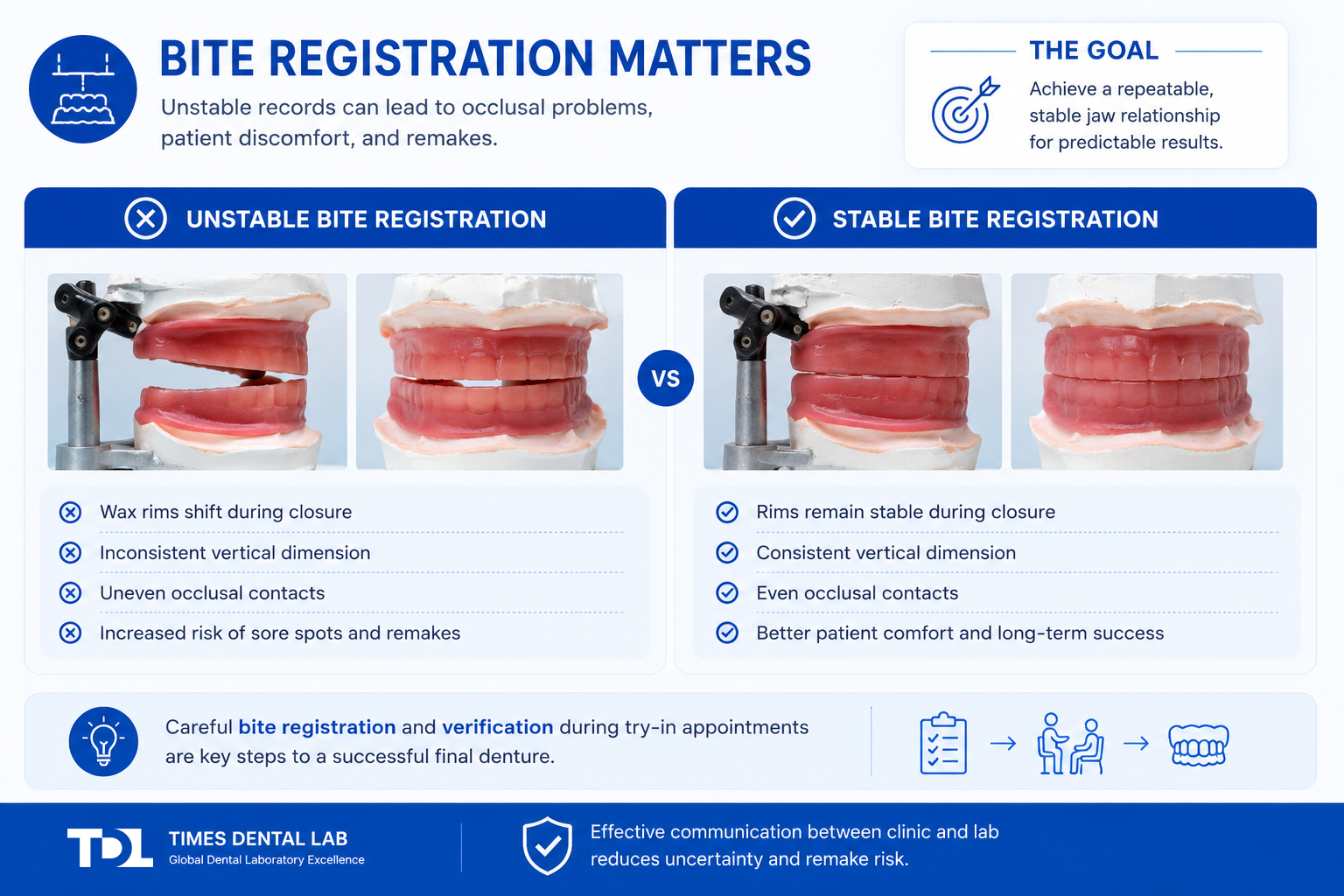
이러한 사례는 변수가 적기 때문에 더 예측 가능하게 동작하는 경향이 있습니다. 예를 들어, 안정적인 상부 및 하부 융선, 명확한 교합 관계 및 기존의 성공적인 의치를 가진 환자는 종종 새로운 설정에 더 쉽게 적응합니다. 이러한 상황에서 시적은 불확실성을 해결하기보다는 세부 사항을 확인하는 데 주로 사용됩니다. 그러나 숙련된 연구실에서는 여전히 이러한 사례를 주의 깊게 검토하고 있습니다. 시도하는 동안 중요한 세부 사항이 무시되면 예측 가능한 사례가 여전히 문제가 될 수 있습니다. 일부 분리 가능한 케이스에는 처음부터 불확실성이 있습니다. 추가 시적은 작업 흐름이 좋지 않아서 발생하지 않는 경우가 많습니다. 사건 자체의 복잡성으로 인해 발생합니다. 다중 의치 시착의 가장 일반적인 이유 중 하나는 불안정한 교합 등록입니다. 전체 틀니의 경우, 특히 하악 틀니의 경우 턱 관계 기록이 항상 일관되게 재현되는 것은 아닙니다. 왁스 테두리가 바뀔 수 있습니다. 환자들은 별도의 진료를 받는 동안 다르게 문을 닫을 수 있습니다. 근육 긴장은 폐쇄에 영향을 미칠 수 있습니다. 수직 크기는 여전히 불확실할 수 있습니다. 이는 특히 다음과 같은 환자에게 흔히 나타납니다. l 수년 동안 착용했습니다.
l 심각한 능선 흡수 l 후방 지원 없음
l 일관되지 않은 폐쇄 패턴 표시 l 일관되게 턱 위치를 반복하기 위해 노력함 때때로 한 약속 동안에는 물린 부위가 괜찮아 보이다가 다음 약속 중에는 바뀌는 경우가 있습니다. 교합기는 여전히 안정적으로 보일 수 있지만 구강 내 기능에는 불일치가 드러납니다. 숙련된 제거 기술자는 일반적으로 다음과 같은 경우에 주의합니다. l 물린 관계가 반복적으로 변경됩니다.
l 닫는 동안 왁스 테두리 이동 l 환자가 매번 다르게 닫힙니다 l 하단 테두리가 불안정함 l 시도 중 설정이 흔들립니다.
이러한 상황에서 의치를 너무 일찍 처리하면 재제작 위험이 크게 높아질 수 있습니다. 턱 관계가 실제로 반복 가능한지 확인하기 위해 추가 시운전이 필요할 수도 있습니다. 심각한 치조골 흡수로 인해 가철성 보철물의 거의 모든 측면이 변화됩니다. 하악 능선이 평평해지거나 좁아지거나 심하게 흡수되면 의치 안정성을 예측하기가 훨씬 더 어려워집니다. 교합기에서 설정이 허용 가능한 것처럼 보이더라도 하부 의치가 기능 중에 움직일 수 있습니다. 이러한 경우: l 왁스 테두리가 불안정해질 수 있습니다.
l 바이트 등록이 변경될 수 있습니다.
l 말하는 동안 설정이 종료될 수 있습니다.
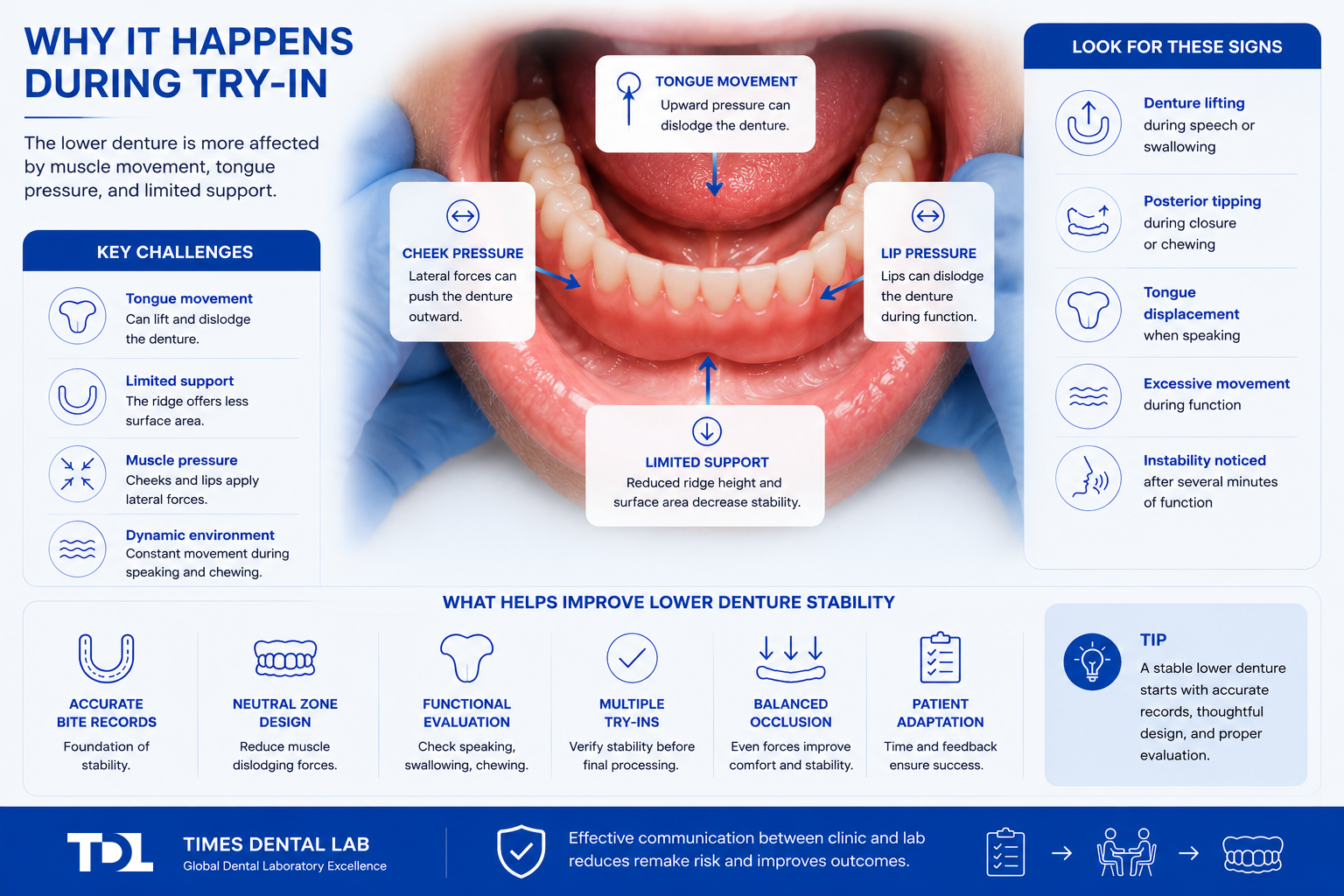
l 교합 압력이 균등하게 분배되기가 더 어려워집니다. l 더 제한됨 이것이 고도 하악 흡수가 진행된 환자가 최종 처리 전에 더 많은 확인을 요구하는 이유입니다. Times Dental Lab에서는 치조제 지지가 제한적인 하부 의치가 환자가 자연스럽게 기능하기 시작하면 다르게 작동할 수 있다는 사실을 종종 발견합니다. 짧은 시운전 중에는 설정이 괜찮을 것 같지만 씹거나 말하는 동안에는 불안정해질 수 있습니다. 이것이 경험이 풍부한 연구실에서 직접 처리에 돌입하는 대신 다른 시도를 권장하는 이유 중 하나입니다. 낮은 틀니의 불안정성은 가철성 보철물에서 가장 어려운 부분 중 하나입니다. 상부 의치는 더 넓은 구개 지지력과 더 안정적인 환경의 이점을 제공합니다. 하악 틀니는 훨씬 더 역동적인 공간에 존재합니다. 혀는 끊임없이 움직입니다. 뺨에 압력이 가해집니다. 삼키거나 말하는 동안 입 바닥의 위치가 변경됩니다. 이것은 잘 만들어진 낮은 설정이라도 일단 환자가 자연스럽게 기능하기 시작하면 다르게 행동할 수 있다는 것을 의미합니다. 때때로 더 낮은 시도에 다음이 표시될 수 있습니다. l 음성 중 의치 리프팅 l 혀 변위
l 불안정한 씹는 패턴
l 후면 팁
l 삼키는 동안 과도한 움직임 이러한 문제가 항상 즉각적으로 드러나는 것은 아닙니다. 어떤 경우에는 환자가 몇 분 동안 말한 후에야 불안정함을 느끼기도 합니다. 이것이 하악 의치 시착을 정적으로만 평가해서는 안 되는 이유입니다. 숙련된 착탈식 기술자가 의치가 모델에서 어떻게 보이는지뿐만 아니라 이동 중에 어떻게 작동하는지 관찰합니다. 미적 문제도 여러 번 시도하는 또 다른 일반적인 이유입니다. 의치는 기술적으로는 잘 맞을 수 있지만 환자가 다음에 대해 확신할 수 없기 때문에 여전히 조정이 필요할 수 있습니다. l tooth --display
l 립 지원
l 얼굴 충만감
l 스마일 라인
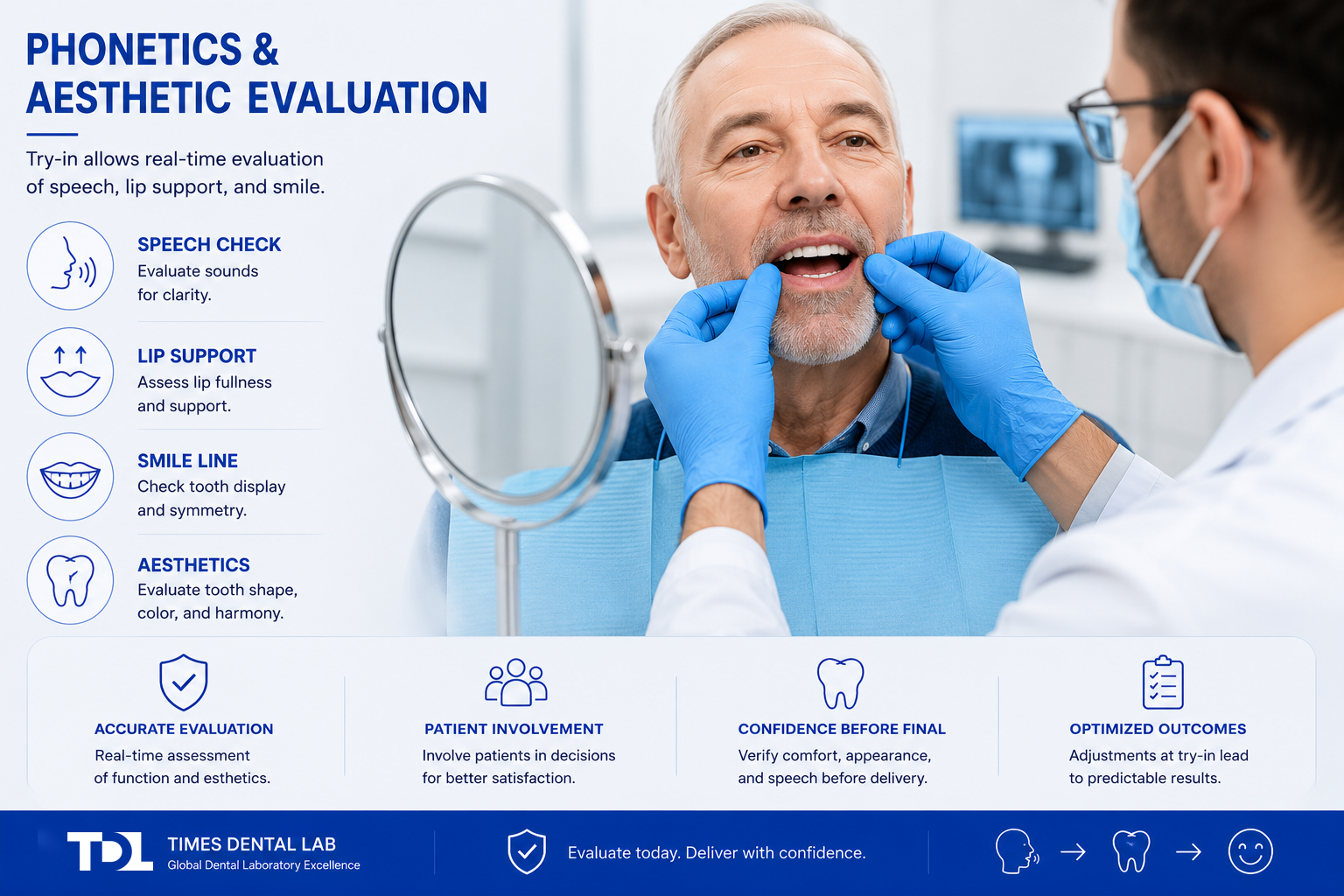
l tooth size l midline position l facial profile This is especially common when the new denture differs significantly from the previous denture. Long-term denture wearers often adapt psychologically and muscularly to their old setup, even if it was technically incorrect. A corrected setup may initially feel “wrong” simply because it is unfamiliar. Sometimes patients request changes only after seeing themselves speaking or smiling naturally. Static photos may not reveal the full esthetic effect. Experienced labs understand that esthetics cannot always be finalized entirely on the articulator. Some adjustments become obvious only during real facial movement. Speech evaluation is one of the most underestimated parts of denture try-ins. Tooth position, vertical dimension, incisal edge position, and palatal contour can all affect phonetics. Patients may struggle with: l S sounds l F sounds l V sounds l tongue positioning l air escape during speech Sometimes these problems appear only after the patient speaks naturally for several minutes. A setup may look esthetically correct but still interfere with speech because: l anterior teeth are positioned incorrectly l the vertical dimension is excessive l the palatal contour affects tongue placement l the lower denture lacks stability during speaking This is another reason why some cases require additional try-ins before final processing. Once acrylic processing is completed, correcting major phonetic issues becomes much more difficult. Large changes from the previous denture often increase uncertainty. This includes: l changing vertical dimension l changing tooth position l correcting collapsed bite l altering facial support l changing occlusal scheme l improving lower denture stability Even when these changes are technically beneficial, patients may need time to adapt. At Times Dental Lab, we often see cases where the old denture had been worn for many years despite poor function. The patient’s muscles adapted to that condition. When a new setup attempts to correct the bite or improve support, the patient may initially feel uncomfortable. In these situations, additional try-ins can help confirm whether the patient is adapting gradually or whether major adjustments are still needed before processing. Experienced removable technicians do not recommend additional try-ins casually. In most cases, the goal is not to slow production. The goal is to reduce uncertainty before final processing. A second try-in is often recommended when: l the bite relationship appears inconsistent l lower denture stability is questionable l esthetic approval remains uncertain l speech problems appear during evaluation l tooth position may still require refinement l the patient cannot adapt comfortably during try-in l the ridge anatomy creates high instability risk This approach is based on long-term predictability. A denture that requires one extra try-in may still save weeks of remake adjustments later. From a removable perspective, processing a questionable setup too early usually increases overall chair time instead of reducing it. The articulator provides a controlled environment. The mouth does not. This difference explains why some denture problems only become obvious during try-in. During function, the patient introduces variables that cannot be fully simulated on the bench: l swallowing l speech l facial expression l cheek pressure l saliva condition l neuromuscular control A setup that appears stable on the model may become unstable once these forces begin interacting with the denture. This is especially true for lower dentures. At Times Dental Lab, we often explain that the try-in stage is where the denture first enters a dynamic environment. The technician can design carefully, but the real functional behavior only becomes visible once the patient starts using the setup naturally. That is why experienced labs observe not only appearance, but also movement. One of the most common removable workflow mistakes is processing the denture before uncertainty is resolved. This often happens when: l delivery deadlines are tight l the patient wants fast completion l the try-in appears “good enough” l small concerns are ignored temporarily However, unresolved issues tend to become harder to correct after processing. For example: l unstable occlusion may create soreness l unresolved esthetic concerns may lead to dissatisfaction l lower denture instability may worsen after acrylic processing l phonetic problems may become more obvious l processing distortion may slightly alter the bite relationship At that stage, adjustment becomes more limited. This is why experienced removable workflows prioritize predictability instead of speed alone. Additional try-ins can significantly reduce remake risk in complex cases. They allow further verification of: l bite consistency l tooth positioning l speech l esthetics l lower denture behavior l patient adaptation l jaw relation stability This is especially important in removable prosthetics because many problems are cumulative. A small occlusal discrepancy combined with lower denture instability and patient adaptation difficulty can quickly become a major complaint after delivery. From a lab perspective, multiple try-ins are often part of preventive workflow rather than corrective workflow. It is usually easier to adjust wax than to remake processed acrylic. Lower dentures are less forgiving than upper dentures. Small discrepancies become more noticeable because the lower denture has: l less support area l no palatal suction l greater tongue interaction l higher muscle interference l more sensitivity to occlusal imbalance Even slight occlusal changes can destabilize a lower denture during chewing. This is why lower removable cases often require additional verification before final processing. At Times Dental Lab, we usually evaluate lower denture try-ins carefully for: l lifting during speech l posterior tipping l tongue displacement l unstable bite closure l unsupported occlusal force l excessive movement during swallowing These details may appear minor during try-in but become much more significant after delivery. Digital dentures have improved removable workflows in many ways. Digital systems help with: l repeatability l data storage l CAD modification l workflow consistency l communication efficiency But digital technology does not eliminate every removable variable. A scan captures anatomy at one moment. It does not fully capture dynamic muscle behavior, patient adaptation, or functional movement. Even highly accurate digital setups still depend on: l stable clinical records l correct jaw relation l functional tooth positioning l patient adaptation l removable experience This is why digital dentures may still require additional try-ins in difficult cases. Technology improves consistency, but it does not completely replace clinical and technical judgment. Experienced removable technicians often notice warning signs before a denture fails. During try-in evaluation, they may watch for: l unstable wax rims l inconsistent closure l lower denture lifting l excessive tongue interference l unsupported posterior setup l shifting jaw relation l unclear speech l overclosed facial appearance l patient hesitation during approval l unstable lower denture movement during chewing simulation These observations are not always dramatic. Sometimes they appear as small inconsistencies. But removable prosthetics often depend on small details. The difference between a stable denture and a problematic denture may come from a slight occlusal discrepancy or a minor positioning issue that becomes amplified during function. At Times Dental Lab, difficult removable cases are approached with a process-based mindset rather than a purely production-based mindset. For complex denture try-ins, our removable team focuses on: l reviewing bite consistency l evaluating lower denture stability l checking tooth positioning carefully l reviewing esthetics dynamically l monitoring occlusal balance l identifying high-risk instability factors l communicating with the clinic before processing questionable setups We believe that additional verification is often preferable to avoidable remakes. Not every difficult case can be made perfectly predictable. But many common denture problems can be reduced when uncertainty is recognized early instead of ignored. For us, removable prosthetics is not only about processing dentures. It is about understanding how the denture will behave after delivery. Some denture cases involve unstable bite registration, lower denture instability, esthetic uncertainty, speech problems, or severe ridge resorption. Additional try-ins help verify these issues before final processing. Yes. In difficult removable cases, multiple try-ins are often part of careful risk control rather than a sign of failure. Yes. Skipping necessary try-ins may allow unresolved occlusion, esthetic, or stability issues to continue into final processing. Lower dentures are more affected by tongue movement, muscle pressure, and limited support area. Small errors tend to become more noticeable during function. Acrylic processing, occlusal changes, muscle adaptation, and functional movement can all affect how the denture feels after delivery. Yes. Digital workflows improve consistency, but difficult removable cases may still require try-ins to verify function, speech, esthetics, and stability. Not every denture case can be finalized safely after a single try-in. In removable prosthetics, additional try-ins are often part of careful evaluation rather than inefficiency. Complex bite relationships, lower denture instability, ridge resorption, esthetic uncertainty, phonetics, and patient adaptation can all affect the final outcome. Experienced removable workflows focus on identifying uncertainty before final processing instead of correcting preventable problems after delivery. At Times Dental Lab, we believe the try-in stage is one of the most important parts of removable treatment. It is where the denture moves from a static setup on the bench into a real functional environment. The more carefully this stage is evaluated, the more predictable the final result usually becomes.
보통 한 번의 시도로 충분한 경우
일부 의치 케이스에 여러 번의 시도가 필요한 이유
불안정한 바이트 등록
심각한 치조 흡수
시적 중 의치 불안정성 감소
미적 불확실성
Phonetics and Speech Problems
Major Changes From the Old Denture
Why Experienced Labs Sometimes Recommend Another Try-In
Why Some Problems Only Appear During Try-In
Why Rushing Final Processing Can Increase Remake Risk
How Multiple Try-Ins Help Reduce Denture Remakes
Why Lower Denture Cases Often Require More Verification
Why Digital Dentures Still Cannot Eliminate Every Try-In
What Experienced Labs Usually Watch for During Denture Try-Ins
How Times Dental Lab Handles Complex Denture Try-In Cases
FAQ
Why do some dentures need more than one try-in?
Are multiple denture try-ins normal?
Can skipping try-ins increase remake risk?
Why do lower dentures often require more adjustments?
Why can dentures feel different after final processing?
Do digital dentures still require try-ins?
Conclusion