Lower dentures are one of the most challenging restorations in removable prosthetics. Even for experienced dental labs, a lower complete denture is rarely a simple “make it fit” case. It involves anatomy, muscle movement, occlusion, ridge condition, tooth position, patient adaptation, and clinical records all working together.
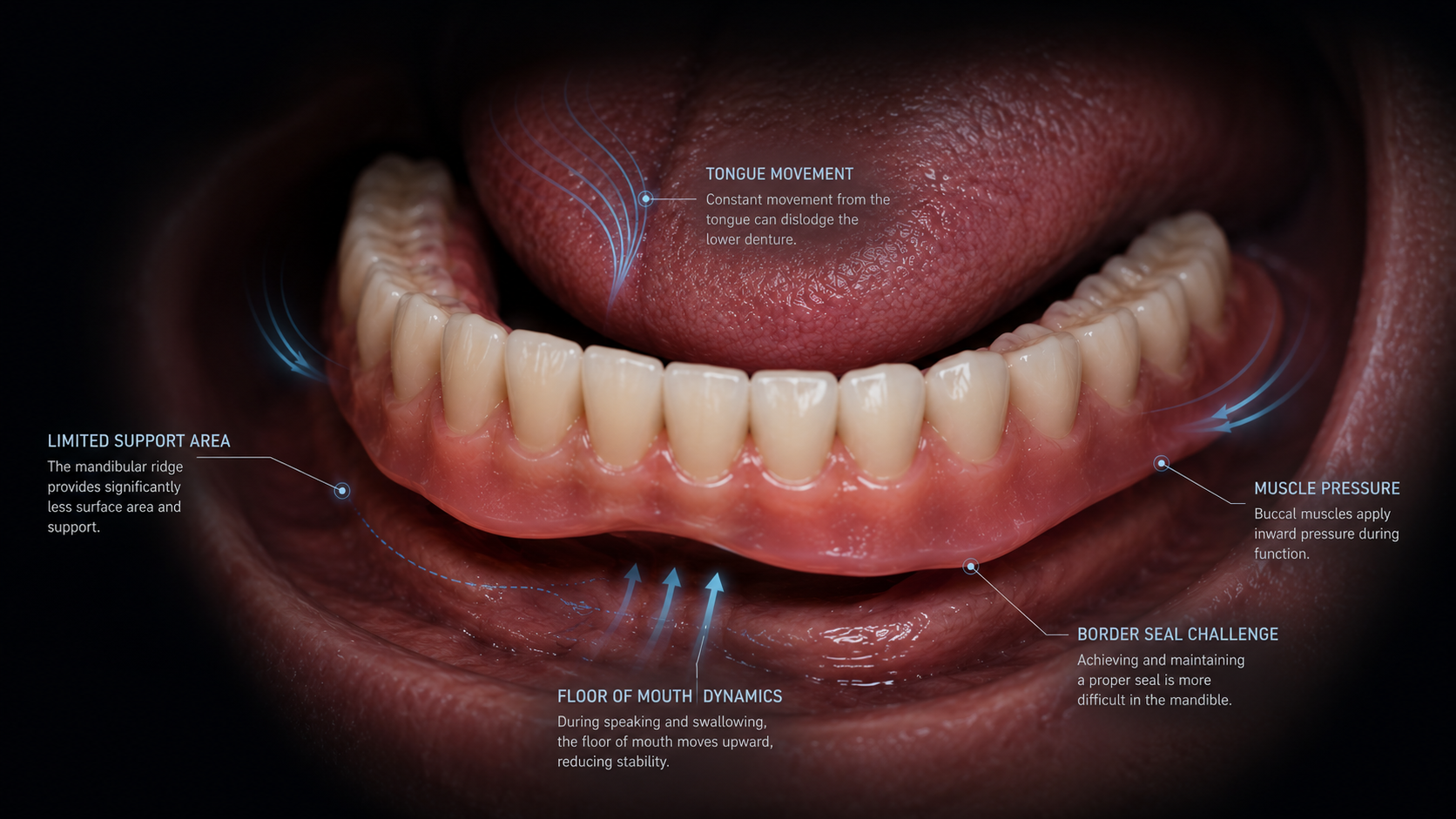
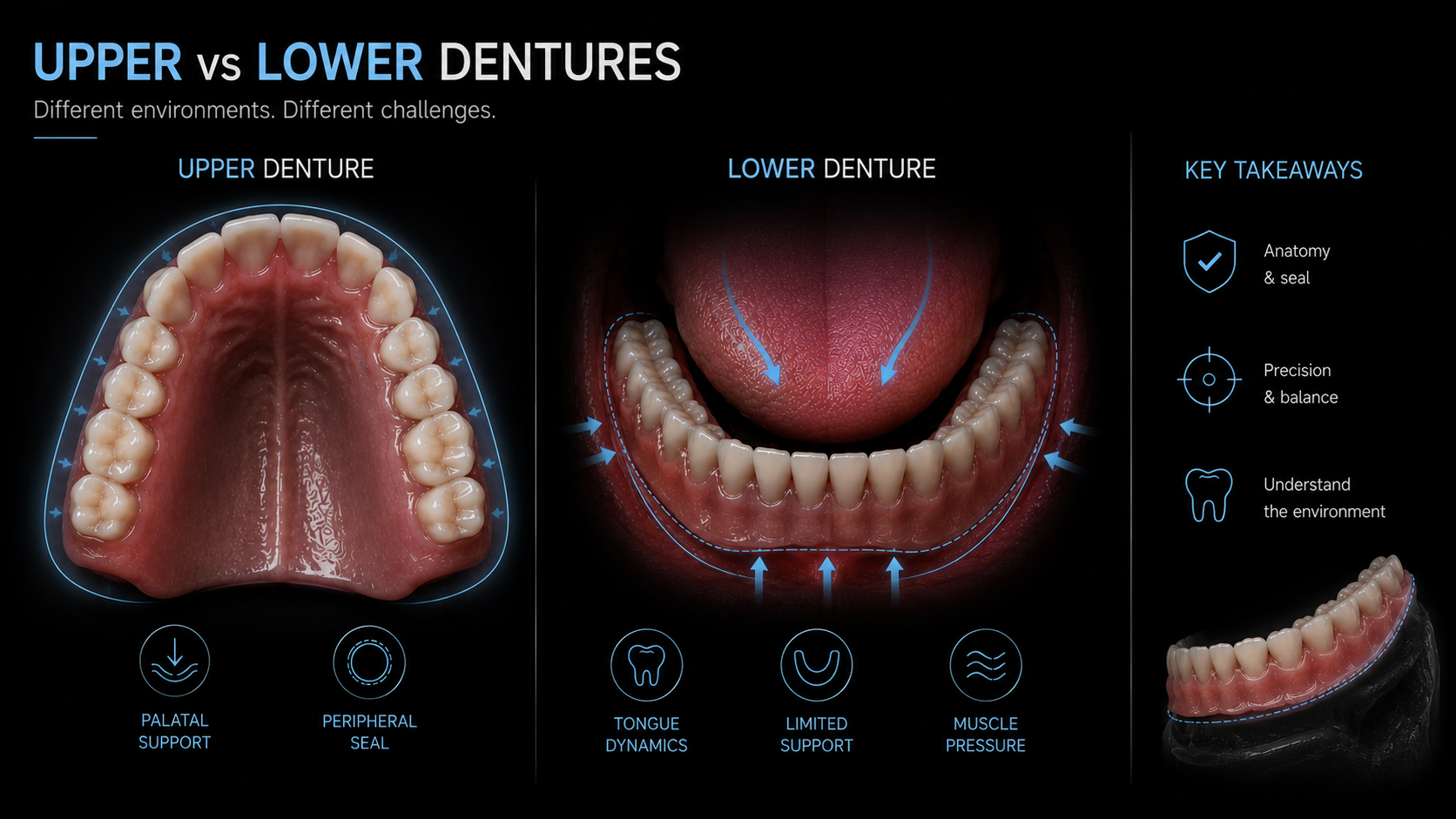
At Times Dental Lab, we often explain lower denture difficulty in one simple way: an upper denture usually has more surface area and palatal support, while a lower denture must work in a much more active space. The tongue moves. The floor of the mouth moves. The cheeks and lips apply pressure. The ridge may be flat or resorbed. The denture has to stay stable while the patient speaks, swallows, chews, and adapts.
This is why lower denture stability is not only a matter of laboratory processing. It is a combined result of clinical records, anatomical limitation, technical judgment, and patient adaptation.
Why Lower Dentures Are Naturally Less Stable Than Upper Dentures
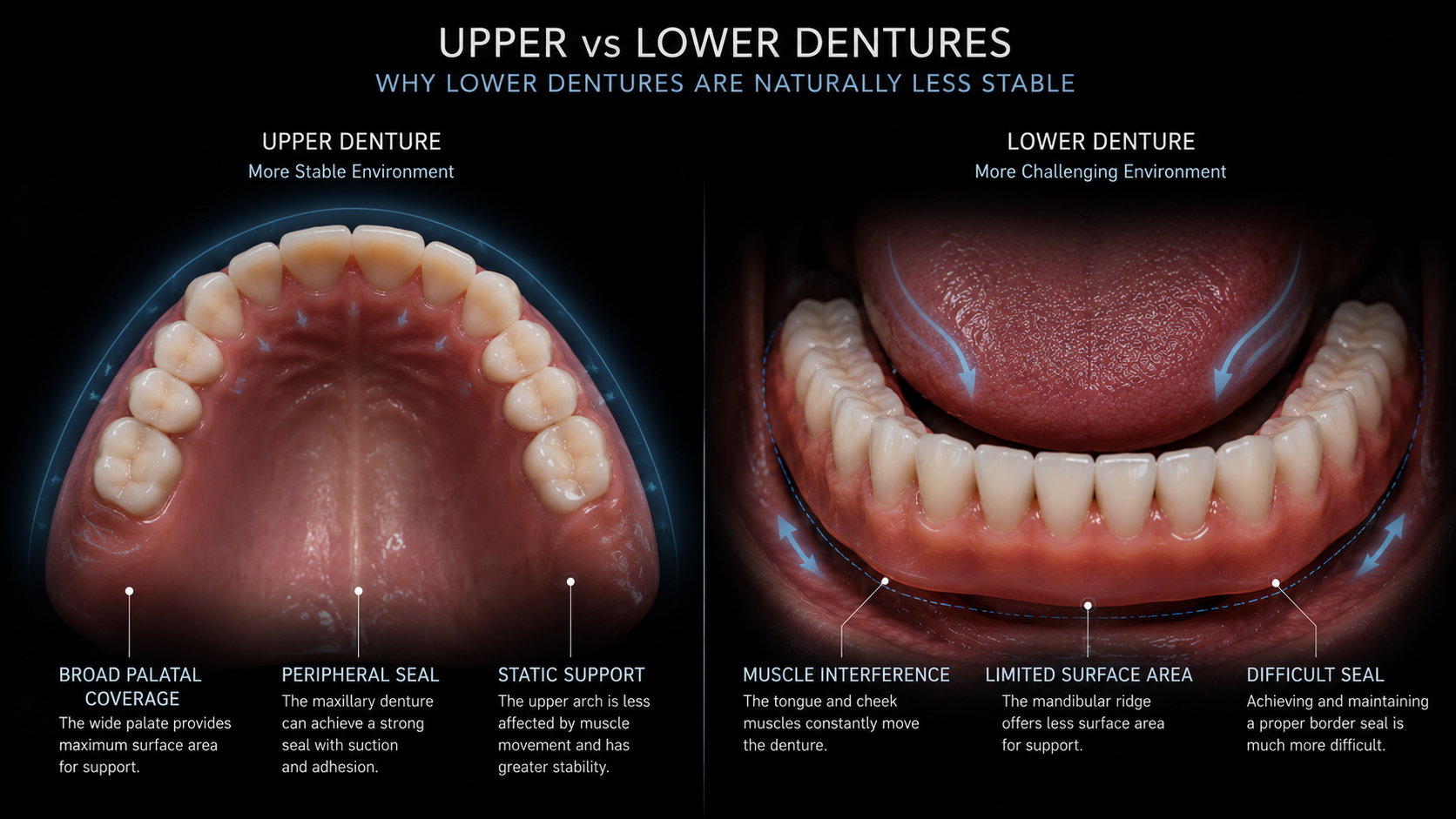
A maxillary denture usually benefits from a broader denture-bearing area. It can cover the palate, create a wider supporting surface, and often achieve better suction. A mandibular denture has a much smaller support area. It cannot use the palate for retention, and it must avoid interfering with the tongue and floor of the mouth.
This anatomical difference is the first reason why lower dentures are harder to stabilize. The mandibular arch gives the lab less room to work with and less surface area to distribute forces. When chewing forces are applied, a lower denture is more likely to tip, rotate, or lift if the supporting tissues, occlusion, or tooth position are not ideal.
The tongue also plays a major role. In mandibular complete dentures, tongue position can directly affect retention and stability. Clinical prosthodontic literature notes that if the tongue retracts when the patient opens the mouth, it becomes very difficult to obtain a good lingual border seal for the lower denture.
This is why a lower denture may look acceptable on a model but feel unstable in the mouth. The model is static. The mouth is not.
The Main Technical Challenges in Lower Denture Cases
1. Border Seal Is More Difficult to Control
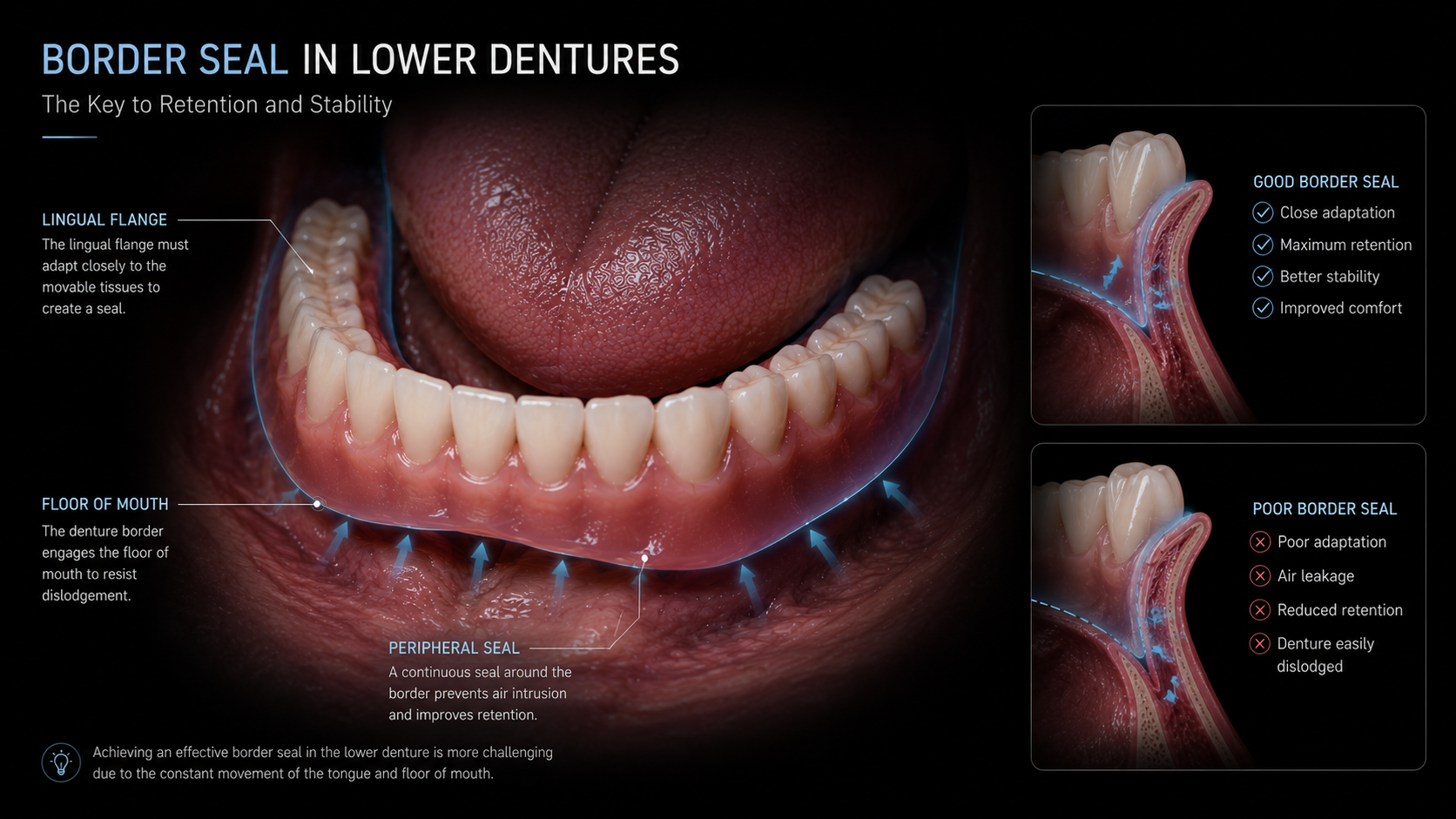
Border seal is one of the most important factors in complete denture retention. For upper dentures, the peripheral seal and posterior palatal seal often provide more predictable support. For lower dentures, the border area is much more dynamic.
The lingual flange must work around the tongue and floor of the mouth. The buccal flange must avoid interference from cheek muscles. The lab must balance extension and comfort. If the border is too short, retention may be weak. If the border is too long or too bulky, the denture may lift during speech, swallowing, or tongue movement.
This is one of the most common reasons why lower dentures are difficult. A lower denture border is not only a physical edge. It is an area that must work together with moving soft tissue.
From a lab perspective, small border design differences can change the final result. Slight overextension may not be obvious on the cast, but it can become obvious when the patient speaks or swallows. Slight underextension may look comfortable, but the patient may complain that the lower denture feels loose.
2. Tongue Movement Constantly Affects Stability
The lower denture sits beside one of the most active muscles in the mouth: the tongue.
During speaking, swallowing, chewing, and resting, the tongue changes position. It can help stabilize a lower denture when it rests naturally against the lingual flange. But it can also dislodge the denture if the flange shape, tongue space, or tooth position is not suitable.
This is why lingual flange design is not just about thickness. It is about respecting tongue space. If the lingual flange is too bulky, the patient may feel crowded. If it is too thin or underextended, the denture may lose support. If the tongue is positioned too far back, lingual seal becomes harder to maintain.
For experienced technicians, this is one of the areas where judgment matters. A lower denture should not fight the tongue. It should work with the tongue as much as possible.
3. Severe Ridge Resorption Reduces Support
Many lower denture cases become difficult because the mandibular ridge has resorbed. A high, broad ridge provides better support. A flat or severely resorbed ridge gives the denture less resistance against movement.
Severely resorbed mandibular ridges are widely recognized as a major challenge in complete denture prosthodontics because they compromise support, retention, and stability. (Lippincott Journals)
In these cases, even a well-made denture may have limitations. The denture may fit the model, but the patient may still feel movement due to poor anatomical support. The soft tissue may be mobile. The ridge may be narrow. The denture base may have very little vertical resistance.
This is why lower denture problems should not always be judged as a simple lab error. Sometimes the case itself has limited anatomical conditions. The lab can improve the design, but it cannot create bone support where it does not exist.
4. Tooth Position Can Make or Break Stability
Tooth setup is one of the most important technical factors in lower denture stability.
If posterior teeth are set too far buccally or lingually, chewing forces may fall outside the supporting ridge area. This can cause tipping. If anterior teeth are set too far forward for esthetics, the denture may lose stability during function. If the occlusal plane is not controlled, the denture may rock during chewing.
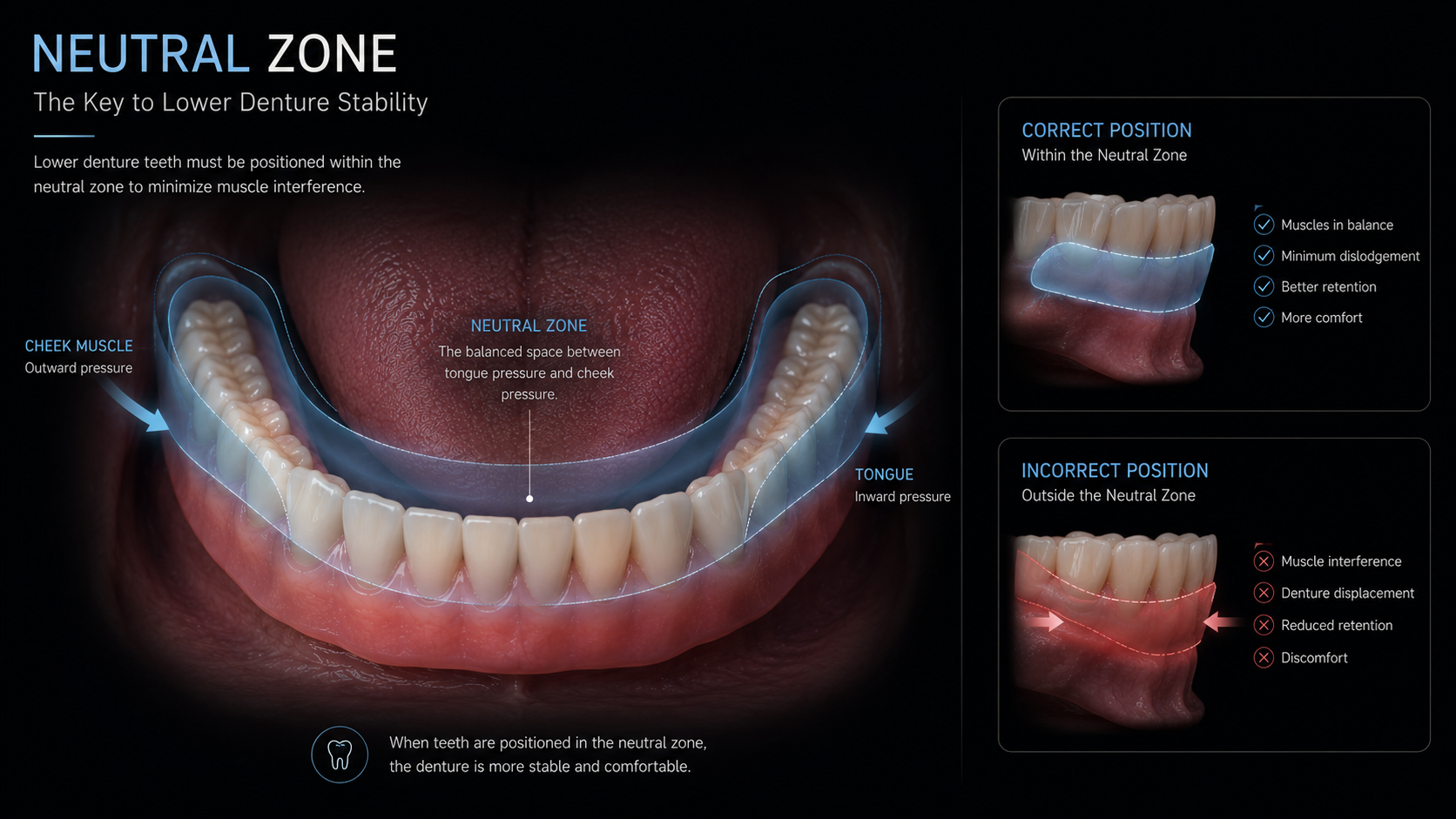
This is where the neutral zone becomes important. The neutral zone is the area where outward forces from the tongue are balanced by inward forces from the cheeks and lips. Denture teeth should ideally be arranged within this zone so that muscle forces help stabilize the denture rather than dislodge it.
For lower dentures, this concept is especially important. A lower denture is surrounded by moving muscles. If the teeth are placed outside the patient’s functional zone, the denture may look good but perform poorly.
At Times Dental Lab, we often see this conflict in real cases. A doctor may ask to make the teeth more visible, more forward, or more similar to the old denture. But if the old denture was already unstable, copying its tooth position can repeat the same problem. This is why technical communication is necessary before final processing.
5. Occlusion Errors Are More Noticeable in Lower Dentures
Occlusion matters in all dentures, but lower dentures are less forgiving.
A small premature contact may not seem serious on the articulator, but in the mouth it can tip the lower denture. Uneven bilateral balance may cause movement during chewing. Heavy contact on one side may create pressure and instability. If the bite registration is inaccurate, the final denture may not function as expected.
Balanced occlusion is important because lower dentures depend on stable force distribution. When occlusal forces are not balanced, the denture may shift. The patient may describe this as looseness, rocking, soreness, or inability to chew.
This is why bite registration is one of the most important clinical records for lower dentures. If the bite record is unstable, the lab must be cautious. A denture made from an unstable bite may still look acceptable, but function can be unpredictable.
Why Some Lower Dentures Feel Stable on the Model but Loose in the Mouth
This is a common question from clinics.
A lower denture may sit perfectly on the model. It may not rock. The base may adapt well. The tooth setup may look balanced. But after delivery, the patient may report movement.
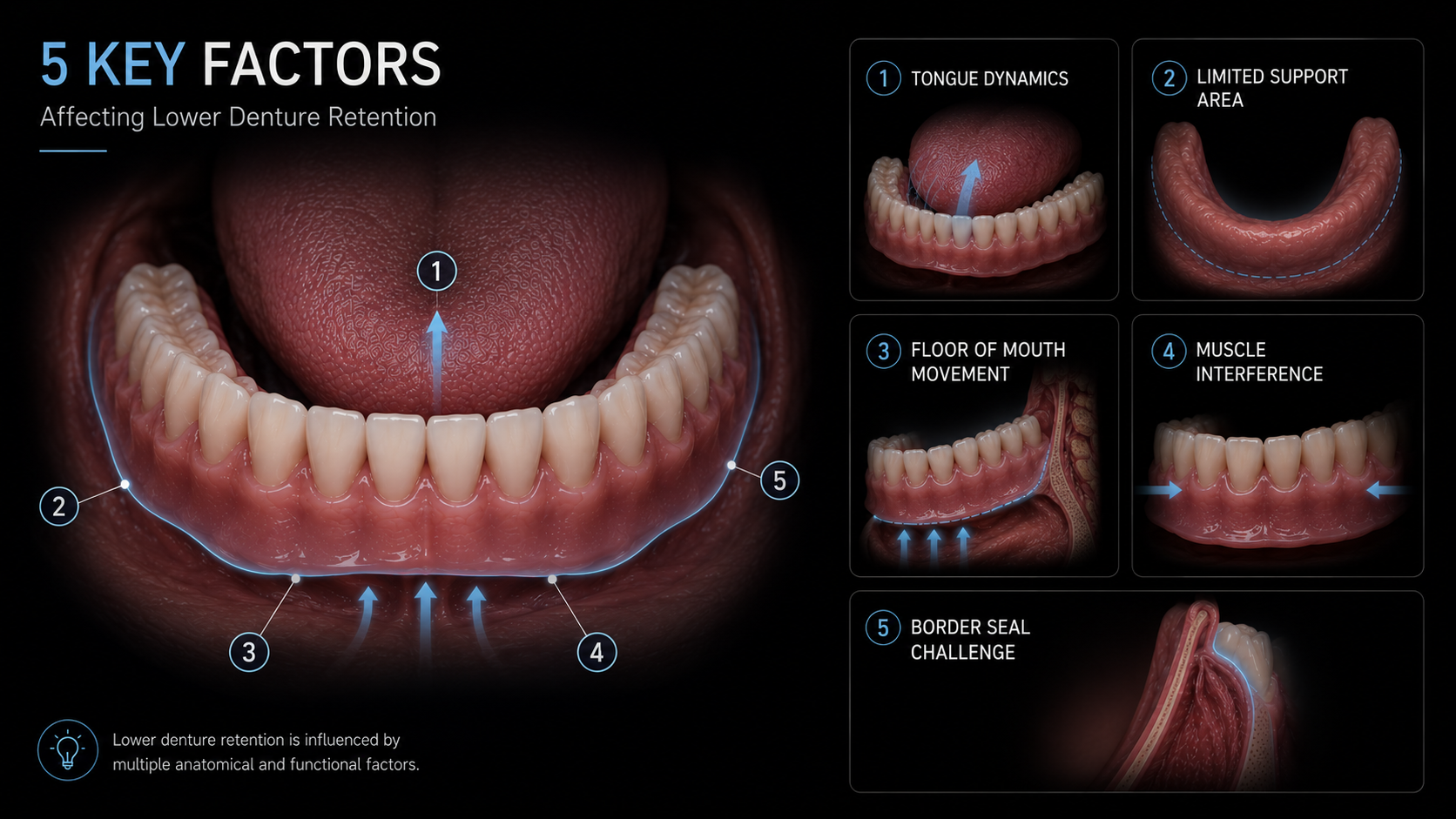
The reason is simple: the model only shows static anatomy. It does not show full tongue movement, floor of mouth movement, saliva condition, swallowing pattern, cheek pressure, or the patient’s muscle control.
A mandibular denture works in a dynamic environment. During speech, the tongue may push against the lingual flange. During swallowing, the floor of the mouth may rise. During chewing, uneven force may tip the denture. During early adaptation, the patient may not yet know how to control the denture with muscles.
This is why a lower denture must be evaluated beyond the cast. The model fit is necessary, but it is not enough. A good lower denture also needs functional stability.
From a lab perspective, we usually separate lower denture instability into several possible causes:
- base adaptation problem
- border extension problem
- occlusion problem
- tooth position problem
- ridge support limitation
- patient adaptation issue
- inaccurate clinical record
This distinction matters. If the true issue is occlusion, adjusting the border may not solve it. If the true issue is tongue interference, remaking the base without changing flange design may repeat the same problem. If the true issue is severe ridge resorption, expectations must be managed carefully.
How Labs Identify the Real Cause of Lower Denture Instability
Experienced labs do not only ask, “Is the denture loose?” They ask, “When does it move?”
That question often reveals the real cause.
If It Moves During Chewing
When a lower denture moves mainly during chewing, the cause is often related to occlusion, tooth position, or ridge support.
The lab may check:
- whether the bite is even
- whether posterior contacts are balanced
- whether one side is hitting heavier
- whether teeth are positioned over the ridge
- whether the denture is tipping under force
If the denture is stable at rest but moves during chewing, occlusion should be reviewed carefully.
If It Moves During Speaking or Swallowing
When movement happens during speaking or swallowing, the problem may be related to border extension, lingual flange contour, or tongue space.
The lab may consider:
- whether the lingual flange is overextended
- whether the floor of mouth is lifting the denture
- whether the tongue has enough space
- whether the patient’s tongue position is unfavorable
- whether the polished surface is too bulky
In these cases, the denture may look stable on the model but fail during function.
If It Feels Loose Immediately After Insertion
If the lower denture feels loose immediately, before chewing or speaking, the issue may involve base adaptation, impression accuracy, border extension, or ridge condition.
The lab may review:
- impression quality
- cast accuracy
- base processing
- tissue adaptation
- flange extension
- ridge anatomy
Sometimes this is a fabrication issue. Sometimes it is a clinical record issue. Sometimes it is an anatomical limitation.
If the Patient Cannot Adapt After Several Adjustments
If the denture has been adjusted several times but still feels unstable, the issue may be more complex. It may involve a combination of ridge resorption, poor neuromuscular control, unrealistic expectations, or unstable bite records.
This is where communication between clinic and lab becomes very important. Photos, pressure indicator marks, bite records, and chairside feedback can help the lab understand what is happening in the mouth.
Why Patient Adaptation Matters More Than Many People Expect
Patient adaptation is often underestimated.
A new lower denture is not only a prosthesis. It is also something the patient must learn to control. The tongue, cheeks, and lips need time to coordinate with the denture. First-time denture wearers may struggle more than experienced denture wearers. Long-term wearers may compare the new denture with an old denture that their muscles have adapted to over many years.
This is why a technically improved denture may still feel strange at first. If the old denture was worn, overclosed, unstable, or heavily adjusted, the patient’s muscles may have adapted to that old condition. A new denture with corrected tooth position or VDO may feel unfamiliar.
The adaptation period should not be ignored. Some early movement may improve as the patient learns to control the denture. However, persistent movement, pain, or inability to function should be evaluated.
From a professional point of view, patient adaptation should not be used as an excuse for every problem. But it should be considered as part of the full diagnosis.
Why Lower Denture Success Is Different for Every Patient
There is no universal lower denture design that works for every patient.
Some patients have a broad ridge and good muscle control. Some have a flat ridge, mobile tissue, dry mouth, strong tongue movement, or long-term resorption. Some patients can adapt quickly. Others need more appointments and careful adjustment.
This is why experienced labs avoid treating every lower denture case the same way.
Important case factors include:
- ridge height
- ridge width
- soft tissue quality
- saliva condition
- tongue position
- cheek muscle activity
- bite record accuracy
- patient’s previous denture history
- esthetic expectations
- chewing pattern
A lower denture is not only a product. It is a functional appliance that must work with the patient’s anatomy and behavior.
Why Digital Dentures Still Require Technical Judgment
Digital denture workflows can improve consistency. They can reduce some manual errors, improve repeatability, and make design modifications easier. Digital records also help with case communication and reproduction.
But digital dentures do not remove the technical difficulty of lower dentures.
A scan captures anatomy at a specific moment. It does not fully capture muscle movement. Software can help design the denture, but it cannot fully predict how the tongue will behave during speech and swallowing. A digital setup may look clean on screen, but the technician still needs to judge whether tooth position, flange contour, and occlusion are suitable.
This is especially true for lower dentures.
Digital workflow is a tool. It is not a replacement for removable experience.
At Times Dental Lab, we see digital dentures as a way to improve control and communication. But lower denture stability still depends on clinical records, anatomical judgment, tooth setup, occlusion control, and final verification.
What Experienced Labs Usually Notice Before a Lower Denture Fails
In many cases, warning signs appear before the final denture is delivered.
Experienced removable technicians may notice:
- the bite record is unstable
- the lower ridge is flat or narrow
- the old denture has poor tooth position
- posterior teeth are requested outside the support zone
- the tongue space looks limited
- the lingual flange may interfere with function
- esthetic requests may reduce stability
- the occlusal plane is not ideal
- the lower denture base has limited support
- the case may need try-in verification
These details are important because lower denture problems often begin early. If the lab only checks the final denture, it may be too late to prevent instability.
This is why we believe quality control should not only happen at the end. It should start from case review.
How Experienced Dental Labs Reduce Lower Denture Problems
A lab cannot control every clinical and anatomical factor. But a good lab can reduce risk through a structured process.
1. Careful Case Review
Before production, the lab should review the impression, bite, opposing arch, previous denture information, and doctor’s instructions.
For lower dentures, the technician should pay special attention to:
- ridge condition
- border information
- bite stability
- tooth position request
- old denture reference
- available vertical space
- esthetic requirements
If something is unclear, communication should happen before processing.
2. Accurate Model and Base Control
The denture base must adapt well to the cast. Any distortion in the model, processing, or finishing can affect fit.
For lower dentures, base stability is especially important because the support area is limited. A small error may cause obvious movement.
3. Controlled Border Design
The border must be extended enough for retention but not so much that it interferes with muscles.
This balance is difficult. It requires understanding the anatomy and respecting the clinical impression. In some cases, chairside border molding information is essential.
4. Tooth Setup Within Functional Limits
Tooth position should support stability, not only esthetics.
If posterior teeth are positioned outside the ridge support area, the denture may tip. If anterior teeth are placed too far forward, the lower denture may become unstable. The technician must balance appearance, phonetics, and function.
5. Occlusion Verification
Occlusion must be checked carefully before delivery. For lower dentures, the lab should avoid obvious premature contacts and unstable bite relationships.
Balanced occlusion is not only a textbook idea. It directly affects whether the lower denture stays stable during chewing.
6. Try-in Evaluation
Try-in is extremely valuable for difficult lower denture cases. It allows the clinic and patient to check esthetics, VDO, tooth position, and bite before final processing.
For high-risk lower denture cases, skipping try-in may increase remake risk.
7. Clear Communication With the Clinic
Some lower denture problems cannot be solved by the lab alone. If the ridge is severely resorbed, the bite is unstable, or the patient has unrealistic expectations, the clinic and lab need to discuss the case early.
Good communication helps prevent surprises after delivery.
How Times Dental Lab Approaches Lower Denture Stability
At Times Dental Lab, lower denture cases are handled with a process-driven mindset. We do not see lower dentures as simple acrylic appliances. We see them as functional restorations that require careful judgment at multiple stages.
Our removable team focuses on:
- reviewing case records before production
- checking model accuracy
- controlling base adaptation
- evaluating tooth setup
- checking occlusion before delivery
- communicating when records are unclear
- reviewing remake causes when problems occur
For us, the key is not only making the denture look correct. The key is reducing avoidable risk.
Some instability issues are caused by clinical records. Some are caused by anatomy. Some are caused by tooth position or occlusion. Some are related to patient adaptation. A responsible lab should help identify the likely cause instead of treating every problem the same way.
This is where experience matters.
When a Lower Denture Should Be Adjusted and When It May Need Remaking
Not every unstable lower denture needs to be remade.
Some issues can be corrected by chairside adjustment:
- minor pressure points
- slight occlusal interference
- small border overextension
- early adaptation discomfort
- minor flange polishing
- Other cases may require relining, rebasing, or remaking:
- poor base adaptation
- incorrect bite registration
- major tooth position error
- severe occlusion mismatch
- distorted impression
- unstable VDO
- major border extension error
The correct solution depends on diagnosis.
For example, if the denture base fits well but the bite is heavy on one side, occlusal adjustment may solve the problem. If the impression was distorted, repeated chairside grinding may not solve the issue. If the ridge is extremely flat, the patient may need realistic expectations, relining, implant support, or another treatment option depending on the clinical situation.
Why Lower Denture Problems Should Be Discussed Early
Lower denture instability is easier to prevent than to correct.
Once the denture is processed, major changes become harder. Tooth position changes may require resetting. Bite errors may require remounting or remaking. Border issues may require chairside adjustment or new impressions.
This is why early communication is valuable.
If the lab sees a high-risk factor, it should inform the clinic. If the clinic sees movement during try-in, it should send clear feedback. If the patient has worn an old unstable denture for many years, that history should be shared.
Better records lead to better decisions.
FAQ
Why are lower dentures less stable than upper dentures?
Lower dentures are less stable because they have a smaller support area and no palatal suction. They also sit close to the tongue, cheeks, lips, and floor of the mouth, which all move during function.
Why do lower dentures move when eating?
Lower dentures may move during eating because of uneven occlusion, poor ridge support, incorrect tooth position, or weak border seal. Chewing forces can tip the denture if they are not distributed properly.
Can lower dentures ever feel completely stable?
Some lower dentures can feel very stable, especially when the ridge condition is good and the patient adapts well. However, lower dentures are naturally more challenging than upper dentures. Severe ridge resorption or poor muscle control may limit stability.
Does digital denture technology solve lower denture instability?
Digital dentures can improve consistency and repeatability, but they do not eliminate all lower denture challenges. Tongue movement, ridge resorption, border seal, occlusion, and patient adaptation still require clinical and technical judgment.
What is the most common reason lower dentures fail?
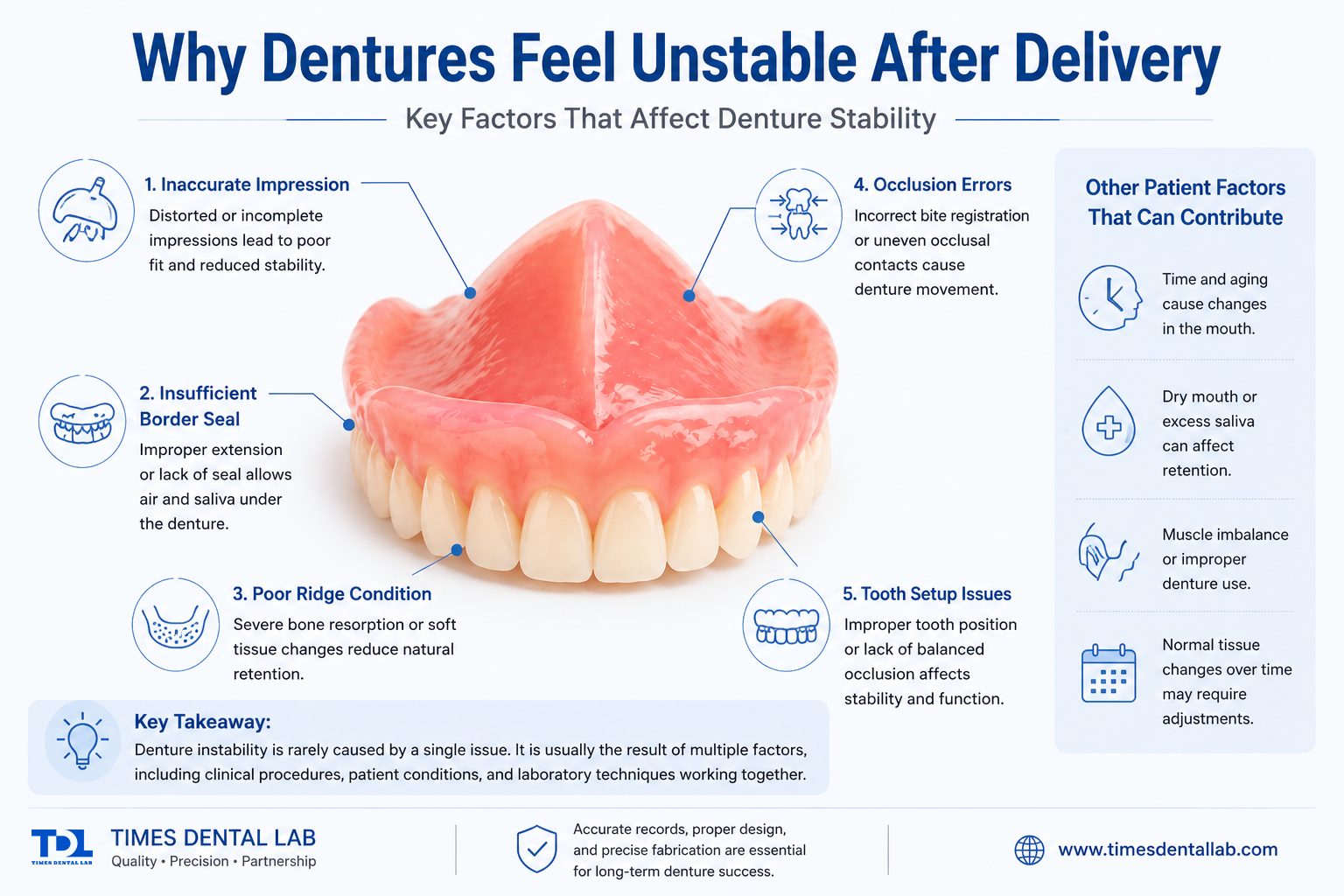
There is no single reason. Common causes include inaccurate impressions, poor border extension, unstable bite registration, severe ridge resorption, incorrect tooth position, occlusion imbalance, and limited patient adaptation.
Should a loose lower denture be remade or adjusted?
It depends on the cause. Minor pressure or occlusion issues may be adjusted. A distorted impression, incorrect bite, poor base adaptation, or major tooth setup problem may require relining or remaking.
Conclusion
Lower dentures are difficult because they are not only supported by anatomy. They must also work with moving muscles, limited ridge support, tongue activity, occlusal force, and patient adaptation.
Even experienced dental labs face challenges with lower dentures because many factors are outside the lab’s direct control. A lower denture may fit the model but still behave differently in the mouth. This is why careful case review, accurate records, functional tooth setup, border control, and clinic-lab communication are essential.
At Times Dental Lab, our approach is simple: lower denture stability should be built through process, not guessed at the final stage. The more carefully we evaluate the case before and during production, the better chance the final denture has to function comfortably for the patient.
Lower dentures will always be challenging. But with the right clinical records, technical judgment, and communication, many common problems can be reduced before they become remakes.