Why Repeatable Quality Depends on the Production System—not One Technician
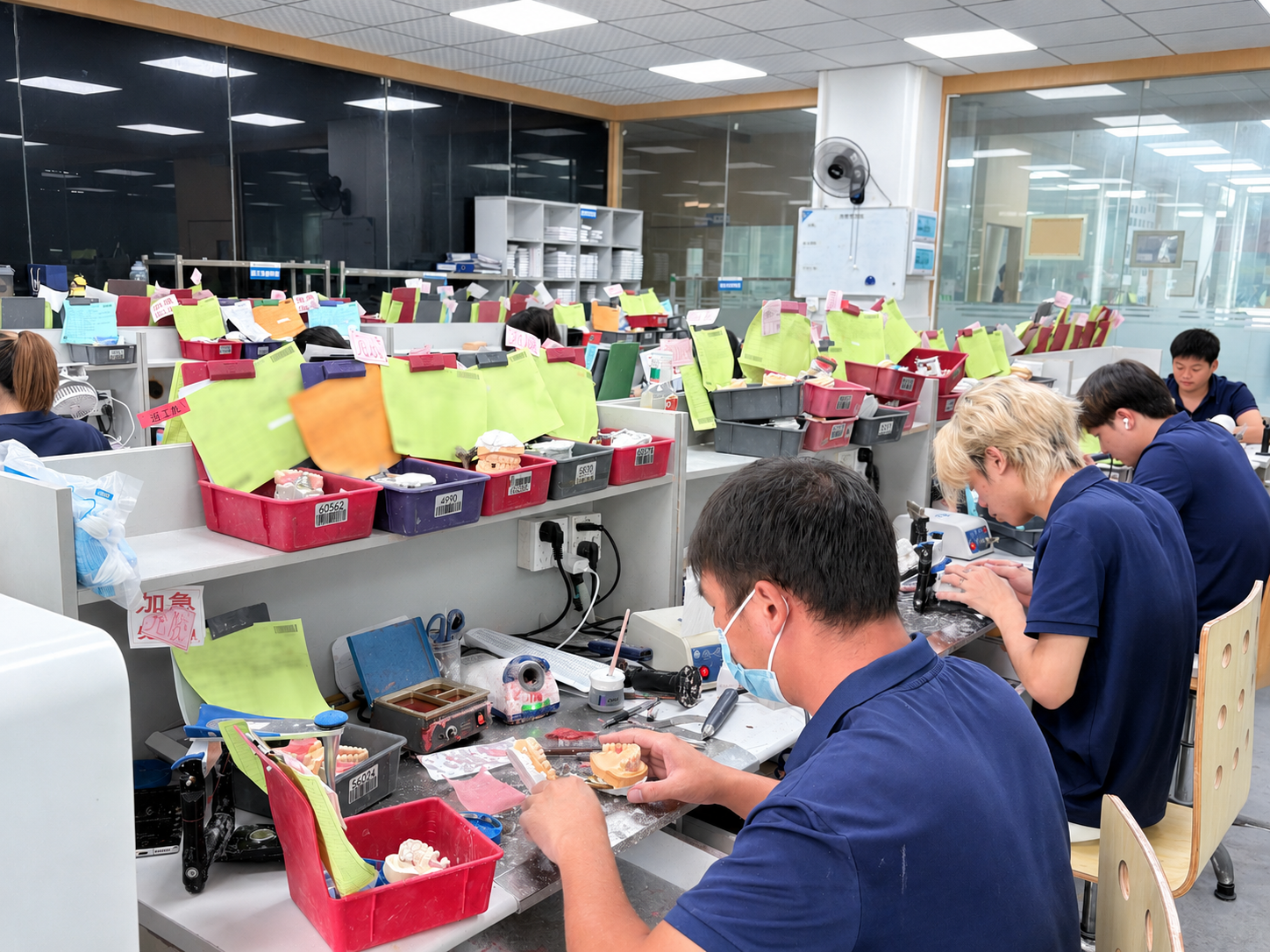
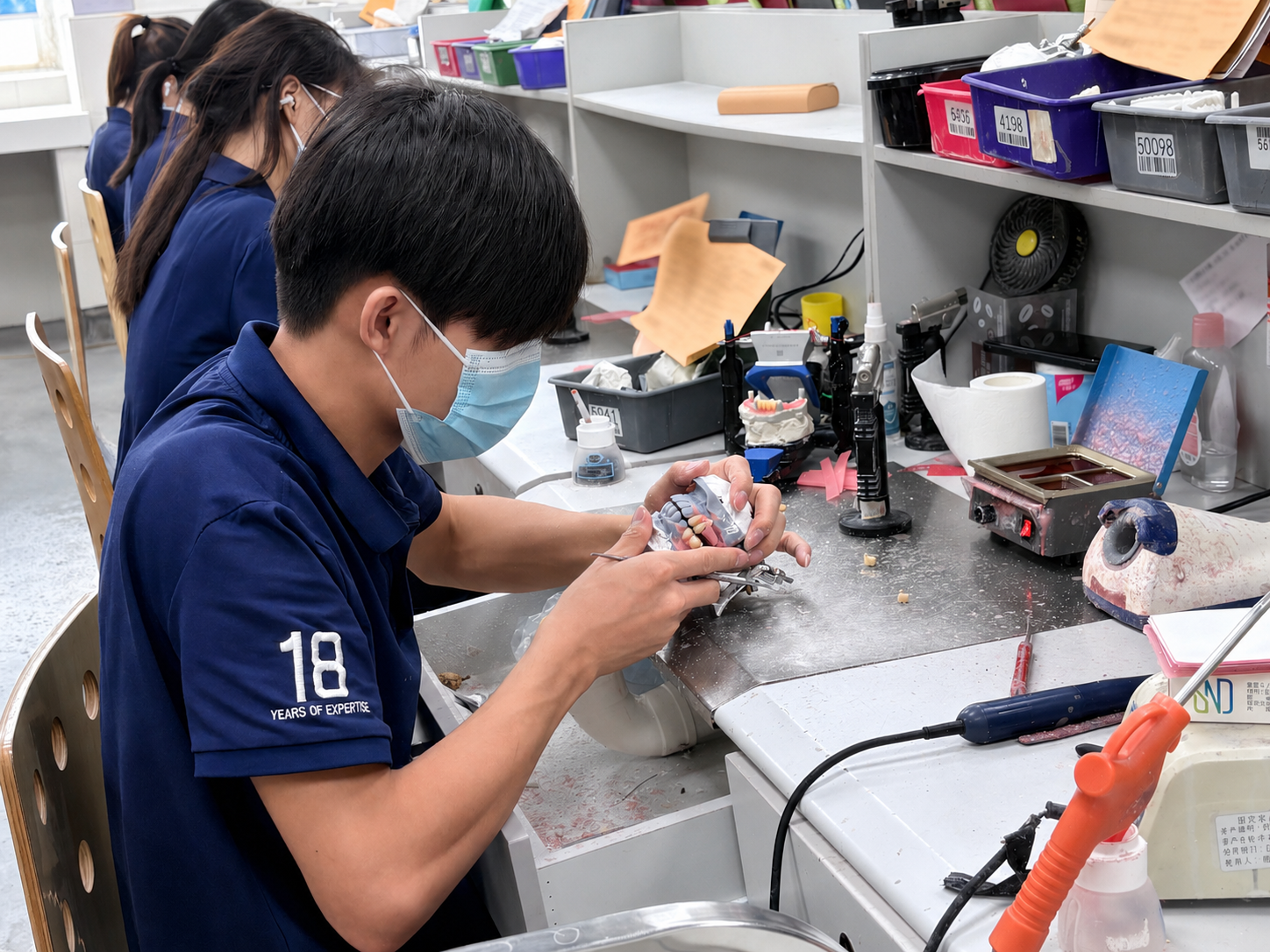
I’m Jimmy, CEO of Times Dental Lab in Shenzhen, China, and Greater Bay Dental Lab in Zhongshan, China. Together, the two laboratories have more than 400 technicians and serve overseas dental laboratories and clinics. Managing quality at this scale has reinforced one lesson: consistent results depend not only on individual skill, but on how the production system handles information, decisions, checks, and feedback.
The overseas partners we work with need more than a good-looking sample: they need the same requirements followed across routine cases, larger batches, and busy periods.
Our approach is built around four practical controls: confirming the necessary case information before production; applying product-specific standards without losing case-specific instructions or standing client preferences; checking work at the stages where problems can still be prevented; and turning recurring feedback into documented corrective action. This article explains why those controls matter in cross-border outsourcing, where failures usually enter the workflow, and how buyers can test a China-based partner before increasing volume. It is based on what we have learned from managing that work in practice.
Clinical requirements and working practices vary by country, client, and product type. If part of this article does not match your workflow, I welcome specific feedback at [jimmy@times-dental.com]
When an overseas clinic or dental laboratory receives inconsistent work from a China-based lab, the first explanation is often: “The technician was not good enough.” Sometimes technician skill is part of the problem. But consistency is influenced by more than the person who works on the case.
The final result also depends on what information reached the lab, how the prescription was interpreted, which design defaults were used, what was checked before the case moved forward, and whether earlier feedback reached the next case.
As volume grows, a lab that depends on a few experienced people to catch every problem becomes harder to control. The consequences usually appear downstream: more technical questions, more chairside adjustment, more remakes, and less confidence from the prescribing side.
Distance does not create every problem, but it makes each missed detail more expensive. A question discovered before production may cost one message; the same question discovered after delivery may cost chairside time, a remake, and another shipping cycle. The underlying weakness is usually in the handoff or control process—not in geography itself.
This article explains where that variation comes from, what a process-driven lab does differently, and what to check before trusting a China-based partner with a larger and more regular case flow.
The Real Problem: Small Variations That Become Normal
Most outsourcing relationships do not break down after one dramatic failure. More often, small exceptions become routine: one extra adjustment, one repeated clarification, or one remake handled without asking whether the same issue has appeared before.
Typical warning signs include:
-
A crown seats on the model, but the clinician still has to relieve the contact or occlusion at the chair
-
Similar cases come back with noticeably different contact pressure, occlusal anatomy, or finishing
-
A repeated instruction is acknowledged, but the same issue appears again in later cases
-
Remakes are completed quickly, but the reasons are not categorized and checked across case numbers
-
Post-and-core restorations repeatedly fail to seat intraorally
One case does not prove that the whole system is failing. But when the same type of adjustment or remake appears across several case numbers, clinicians, or production weeks, it should be treated as a pattern worth investigating—not dismissed as a series of unrelated cases.
For recurring or significant quality problems, we use a corrective and preventive action (CAPA) log to link the problem to the relevant case, assign responsibility, and check what was done. The detailed review process is explained below.
Cross-Border Outsourcing to China: Where Problems Usually Enter the Workflow
When the prescribing side is overseas and production takes place in China, the problem may appear only when the case is delivered or seated. But it may have entered the workflow much earlier—during case submission, clarification, design, production, or a handoff between teams.

Common failure points include:
-
Incomplete or ambiguous case records: A margin is not clearly visible, an opposing scan or bite record is missing or questionable, shade information lacks useful photographs, or the implant system and scan body cannot be identified confidently. The risk is not only missing data; it is that the laboratory fills the gap with its own default—in effect, guessing without enough information—which naturally increases the likelihood of failure.
-
Digital files and revisions: Both sides need to agree which records form the complete case package, which file formats can be used, and which version is approved for production. If a revised scan or instruction is sent, the older version must be clearly withdrawn and the new version explicitly designated as the production version.
-
Long clarification loops: A question raised near the end of one side’s working day can delay the answer until the next production day. If the issue is discovered only after physical delivery, the next loop may also involve photographs, a return shipment, a new scan or impression, and another production cycle.
-
Unwritten client-specific preferences: The client may expect a special model, contact, anatomy, design, or approval method, while the production team assumes the laboratory’s normal default applies. A preference that lives only in previous messages or one experienced person’s memory is easy to lose during routing or staffing changes.
-
Remakes reviewed as isolated cases: If the review records only that a replacement was made, but not the case number, observable problem, available clinical evidence, likely entry point, and preventive action, similar cases cannot be compared and recurrence is difficult to detect.
These issues are often called “communication problems,” but sending a message is not the same as controlling an instruction. The practical questions are whether the requirement was recorded in the right place, linked to the correct case, used to stop production when clarification was necessary, and checked again on later cases. When those safeguards are missing, distance exposes the weakness.
Before production begins, both sides should separate three things: the requirements for this individual case, the client’s standing preferences, and the laboratory’s normal defaults. They are not interchangeable. A note about one doctor, one component, or one special case should not automatically become a general production rule; likewise, a long-standing client preference should not depend on one person remembering an old message. Managing these distinctions requires a clear SOP that the whole team follows consistently.
Why Technician-Dependent Quality Becomes Unreliable at Scale
In a small lab, experienced technicians can often review cases directly and remember individual doctors’ preferences. This can work well while the team is small and the case flow is limited. The weakness is that much of the working standard may live in people’s memory rather than in a shared process.
As volume increases, three things change:
-
1. Senior technicians can personally review a smaller share of the total case flow
-
2. Cases pass through more designers, technicians, teams, shifts, or production locations
-
3. Exceptions are more likely to be handled by someone who does not know the client’s full history or earlier feedback
At that point, quality is no longer controlled only by a few experts. It also depends on whether the process makes the correct routine decisions repeatable and makes unusual cases visible before they move forward.
If quality depends mainly on who touches the case, consistency will fluctuate when workload, staffing, product mix, or case routing changes. A prospective partner should therefore be able to explain which standards and checks remain the same when a case moves between technicians or teams.
Strong craftsmanship still matters, especially in esthetic and complex cases. A good system does not remove technical judgment. It turns routine decisions into clear standards, defines when a technician should stop and escalate, and checks critical work before the case moves to the next stage. The goal is not to replace experts; it is to avoid needing the same expert to rescue every case.
Skill Is Essential, but It Cannot Correct Missing Information at Every Stage
Technical skill remains essential. But even an excellent technician can work only with the information and decisions available at each stage. If the prescription, clinical records, or agreed defaults are unclear, an attempt to “fix” the case may simply replace missing information with an assumption.
Some variation is already embedded before design starts, for example:
-
A missing or questionable bite record or opposing scan
-
A finish line that is not consistently visible in the scan or impression
-
A prescription that leaves a design choice unstated, with no agreed default to fill the gap
-
Small variations introduced by the scan, model, design setting, material, or manufacturing process—even when each remains within its own acceptable range
A skilled technician can often recognize an ambiguity and find a workable solution. But that compensation is still a decision. If the reason and chosen solution are not recorded, another technician may make a different decision on the next similar case. Individual correction can save one case; it does not by itself create repeatability across many cases.
Example: How Small Deviations Add Up (“Tolerance Stacking”)
A small deviation at one stage may not create a visible problem on its own. But if small shifts from the scan, design, model, and manufacturing process move in the same direction, the final restoration may require adjustment even though no single stage appears far outside its allowed range.
Hypothetical example:
-
The scan makes part of the finish line or preparation slightly uncertain
-
The restoration is designed near the tighter end of the agreed internal-gap range
-
Milling or sintering and the working model each introduce a small amount of normal process variation
Each factor may be “within tolerance.” But the patient and clinician experience the combined result. In this hypothetical example, the restoration may seat too tightly or fail to seat fully; incomplete seating may then also present as a high occlusion.
This is not automatically proof of poor craftsmanship. It is a reason to trace the input data, design decision, model, manufacturing steps, and inspection result together instead of judging only the last technician who touched the case.
What Defines a Process-Driven Dental Lab
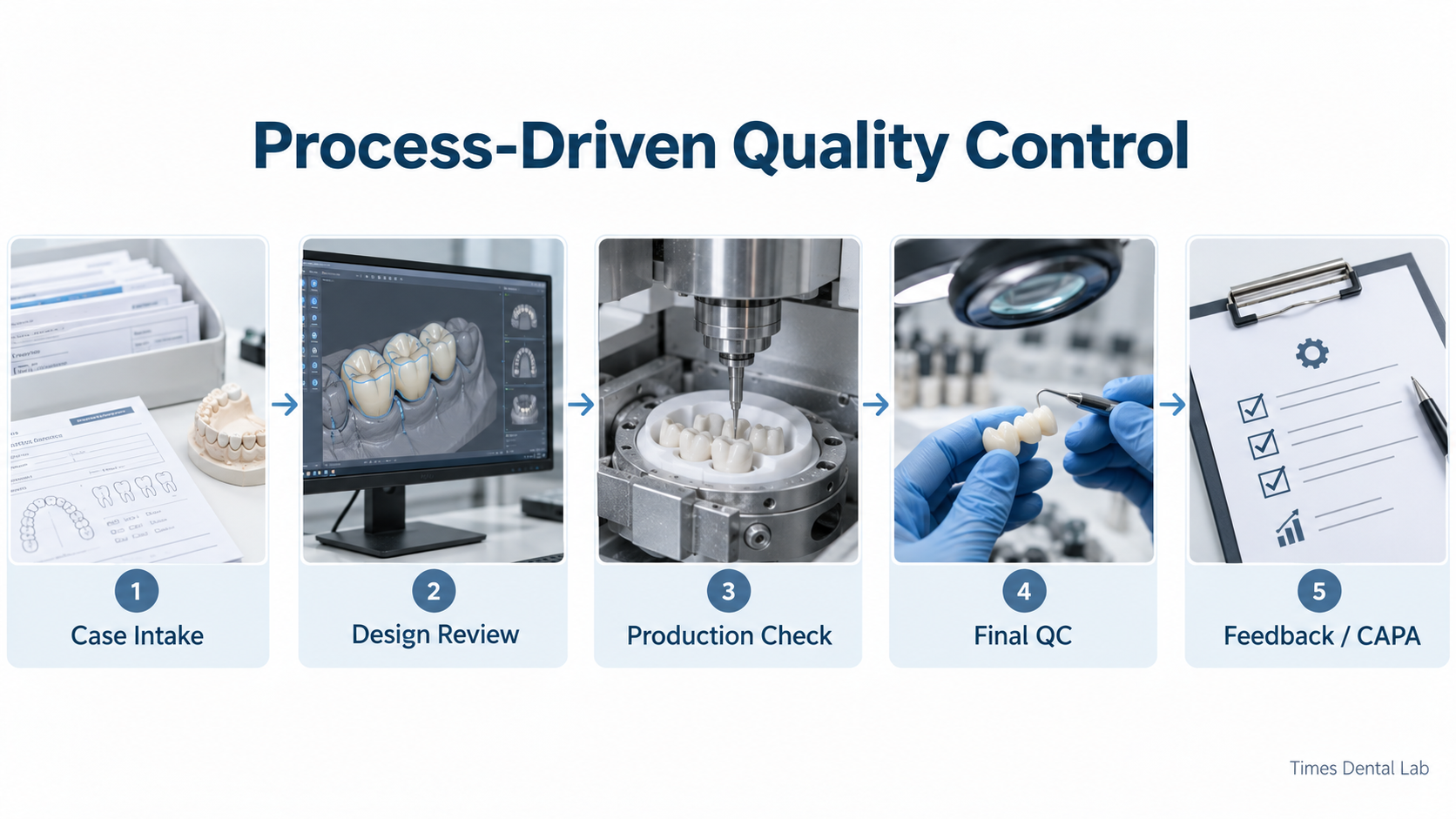
A process-driven lab is not defined by how many scanners, printers, or milling machines it owns. It is defined by how requirements are recorded, how routine decisions are standardized, how exceptions are escalated, and what is checked before work moves forward.
The goal is to identify and control a problem at the earliest practical stage instead of relying on final QC—or the clinician—to discover it after the work is finished.
In practice, that requires the following controls:
1) A Clear Go/No-Go Check Before Design
Cases are reviewed before design to confirm the product, material, tooth number, shade, required files, bite or opposing records, visible margins, implant details where applicable, and any special instructions. If missing or questionable information could materially change the result, production should pause for clarification.
At the same time, an intake check should not become an excuse to send unnecessary questions. An experienced team should distinguish between information that must come from the client, a choice already covered by an agreed default, and an internal technical decision the laboratory can make responsibly. Early clarification protects the schedule only when the questions are necessary and raised clearly.
2) Written Design Defaults—and Controlled Exceptions
Core parameters should have written defaults for each relevant product category. Depending on the product, these may cover internal fit or cement space, minimum thickness, contact and occlusion approach, material or manufacturing limits, and other repeatable design decisions.
A special case may need a different setting. The difference should be linked to that case or client, reviewed by the appropriate person, and communicated to the next step. It should not become an undocumented adjustment made differently by each designer.
3) Escalate Repeated Issues, Not Just Individual Remakes
When recurring adjustments or remakes appear, the immediate case still needs to be corrected or remade, but the investigation should not stop there. Compare the observable issue across case numbers, product types, clinicians, production periods, teams, and available records. Start with what can be seen and verified before deciding whether the cause lies in the incoming data, interpretation, design, production, inspection, clinical conditions, or a combination of factors.
The question is not only “Who made this case?” It is also “What condition keeps appearing, and what must change to prevent it?”
4) Root-Cause Review That Ends in Verified Action
Returned cases and documented clinical complaints should provide enough information for a structured review. Depending on the issue, the record should include:
-
The case number and observable problem—what was seen, not an assumed cause
-
Available evidence, such as photographs, scans, impressions, models, prescription history, or the returned item
-
The confirmed root cause or contributing factors, with uncertainty left visible where the evidence is incomplete
-
The immediate correction for the affected case and the preventive action for later cases
-
The responsible owner, due date, evidence of completion, and QC verification
-
Any required update to the SOP, checklist, client preference, parameter default, or training
Without this loop, a team may remake the unit or repeat a verbal reminder without knowing whether the same problem returns. For recurring or significant quality issues, we use a CAPA log to assign responsibility, set the required action and deadline, record actual completion, and obtain QC verification. The record also shows whether the SOP or training needs to be updated. This creates a traceable path from the original problem to the action taken instead of closing the matter after an apology or remake alone.
5) Product-Specific Teams With Shared Standards
Segmenting teams by product family allows technicians and reviewers to build deeper familiarity with the recurring decisions, materials, components, and inspection points in that category. Fixed restorations, implant work, removables, orthodontic appliances, and digital design do not present the same production questions.
However, specialization works only if client requirements and quality rules travel with the case. A flexible general pool may help capacity, but complex work should still be routed according to verified competence and clear escalation rules rather than availability alone.
6) Review Trends Before Complaints Become Normal
Track recurring indicators over time, such as:
-
Remake rate by product category and recorded issue type
-
Chairside feedback separated into contact, occlusion, seating, margin, shade, anatomy, finishing, and other useful categories
-
Repeat issues by client, clinician, product, production period, or other relevant grouping
-
Production and delivery performance by product type, with the reason for delays recorded rather than only the final date
-
Whether corrective actions recur, remain open, or pass later verification
If trend signals are visible early, intervention can be preventive rather than reactive. The exact KPI set should match your product mix. More important than any single number is using the same definitions over time, reviewing the results on a fixed schedule, identifying repeated categories, assigning action, and checking whether that action worked. Tracking a number without changing the work is reporting, not control.
Why This Matters More When Production Is Offshore
Outsourcing adds distance and handoff complexity. When communication loops are longer, instability becomes more expensive.
In offshore partnerships—including China-based manufacturing—consistency affects:
-
Remake and logistics cost
-
Delivery predictability
-
Clinical chairside time
-
Long-term trust between partners
Many outsourcing failures are not caused by being in China. They are caused by structural mismatch between partners.
If one side expects the same requirements to be followed from case to case while the other relies on individual technicians to correct problems as they appear, friction is inevitable—regardless of how skilled those technicians are.
How to Vet a China-Based Lab Partner: Questions and Practical Checks
The following questions help distinguish process maturity from sales claims. Use them in early discussions, pilot programs, and periodic reviews.
|
Question |
Why it matters |
What to verify |
|
What makes your team stop a case and ask for clarification? |
Some gaps require clinical or client input; guessing creates avoidable risk. |
Ask which missing, unclear, or abnormal records trigger a stop before design or production. |
|
How are my preferences recorded and carried into later cases? |
A requirement stored only in an old message or one person’s memory is easy to lose. |
Ask how the lab distinguishes a standing client or clinician preference from a one-case instruction, and how it updates that preference after feedback. |
|
Which decisions require my approval, and which can the lab make? |
Clear decision boundaries reduce unnecessary questions without encouraging guesswork. |
Ask for examples of a decision that requires client approval, one covered by an agreed default, and one handled internally by the technical team. |
|
What happens when the same remake issue appears again? |
A quick remake solves the immediate case but does not prevent recurrence. |
Ask for an anonymized example of a recurring issue and what changed in the process, check, parameter, or training afterward. |
|
How should we evaluate a trial order? |
A useful trial tests the workflow as well as the finished restoration. |
Agree on the product, records, defaults, approval points, and review criteria before production starts. |
|
What remains consistent when volume increases? |
Growth exposes standards that depend on individual memory or last-minute correction. |
Ask which written requirements and checks remain the same across technicians, teams, and busy periods. |
If the answers depend mainly on verbal assurance or the memory of one salesperson or technician, the buyer should expect requirements to become harder to repeat as the relationship grows.
A pilot should begin with one clearly defined product type and a small, regular batch—not a single “showcase” unit. Review fit, esthetics, communication, and delivery separately. Then check whether the agreed instructions and first-round feedback are carried into the next batch. A successful trial provides evidence for that product and workflow; it does not prove performance across every product category.
How We Build Consistency Into Daily Production
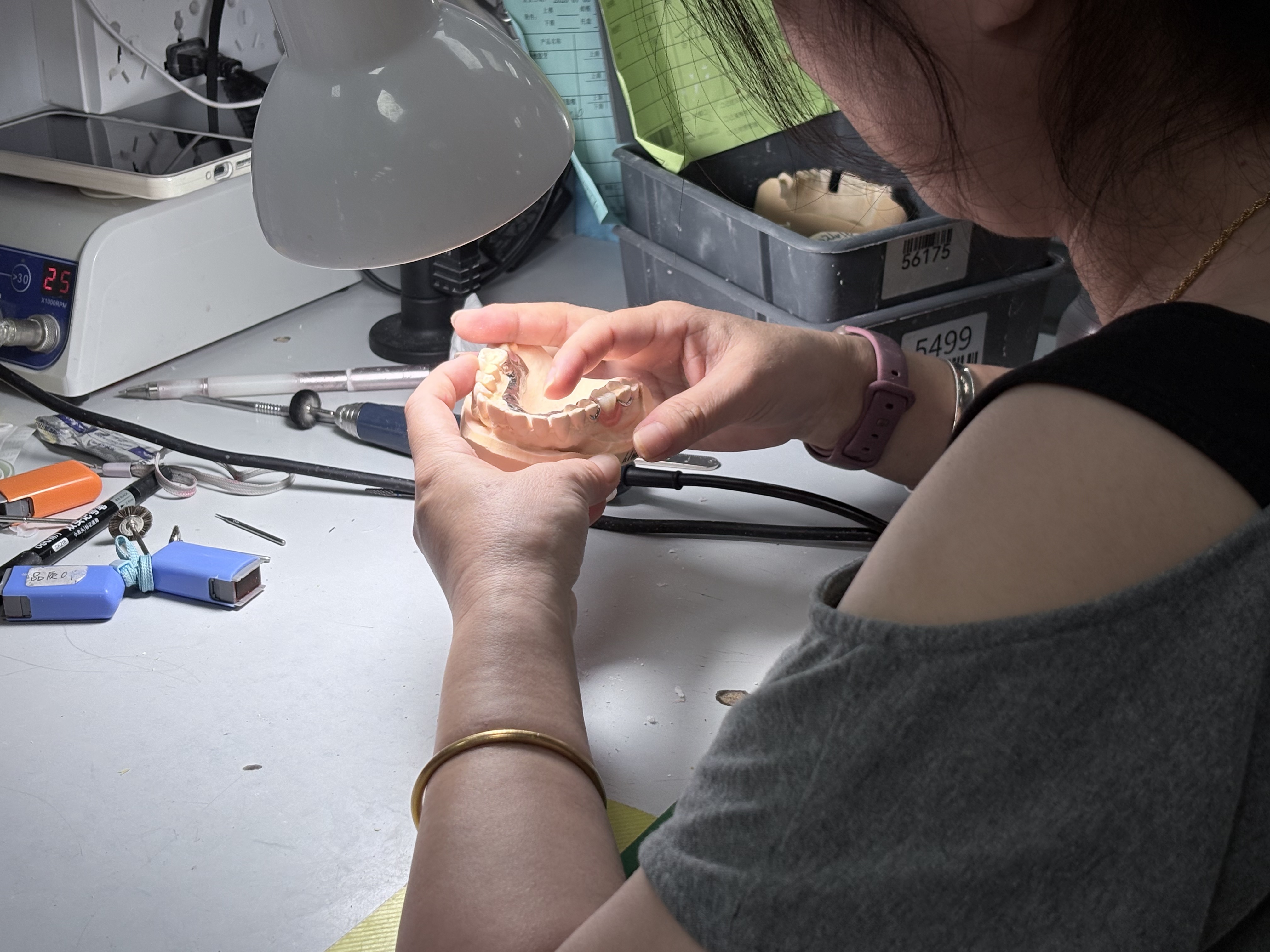
Our quality-control approach focuses on making customer requirements visible before they are lost in production and making repeated problems lead to a documented change. No quality system eliminates every remake. The purpose is to catch avoidable problems earlier, make decisions traceable, and reduce recurrence.
In daily work, that means:
-
Checking the case before design: We review the product, material, tooth number, shade, required files, bite or opposing records, implant information where applicable, and special instructions. If missing or abnormal information could materially change the result, the case should pause for clarification.
-
Separating three kinds of requirements: We distinguish the instruction for one case, the client’s or clinician’s standing preference, and the laboratory’s normal default. A special instruction should not silently become a general rule, and a standing preference should not depend on one person remembering it.
-
Asking the questions that genuinely need an answer: A good quality system does not mean asking the client about every small decision. It means knowing which questions require clinical or client input, which choices are already covered by an agreed preference, and which technical decisions the laboratory should be able to make responsibly.
-
Checking at relevant stages—not only at final QC: Checks during design and production matter because final inspection cannot fully correct a case that began with missing information or a misunderstood instruction.
-
Using CAPA when a problem is recurring or significant: The issue is linked to the case, assigned to a responsible owner, given corrective and preventive actions and a deadline, and checked by QC after completion. The review also determines whether an SOP or training update is needed.
-
Carrying feedback into later cases: The response should not end when a replacement is completed. Later cases need to show whether the agreed correction was understood and maintained.
Craftsmanship remains essential, especially in esthetic and complex work. Our quality-control philosophy is to support that skill with clear information, repeatable decisions, timely escalation, and checks at the stages where they can still prevent a problem. A remake solves the immediate case; quality control should also reduce the chance that the same problem happens again.
Final Takeaway
A lab may produce one good case through individual experience. Consistency depends on whether the correct information, decisions, and checks can be repeated across ordinary cases—and whether feedback changes what happens next.
If you are evaluating a China-based lab, do not judge only by one attractive sample. Start with a clearly defined product and a small, regular batch. Agree on the records, defaults, approval points, and evaluation criteria before production begins. The real test is not whether the lab can make one good case—it is whether your requirements are understood, repeated, and improved over time.
Every outsourcing relationship has its own pressure points. What recurring problems have been hardest to resolve in your current outsourcing partnerships? If you have not outsourced yet, what concerns are holding you back? Share your experience or questions in the comments—I’d be glad to discuss them with you.
*Written by Jimmy, CEO of Times Dental Lab and Greater Bay Dental Lab.*