Quick Answer
There is no single best dental crown margin design for every crown. A chamfer, shoulder or feather-edge margin must match the material, restoration thickness, marginal strength, cementation or bonding method and esthetic requirement. For the dental lab, a clear, continuous and scannable finish line is often more important than the margin name alone. The final preparation design should be selected by the clinician according to the case, the restoration material and the manufacturer's instructions.
Why Crown Margin Design Matters to the Dental Lab
Crown margin design affects how clearly the dental lab can identify the finish line, mark the CAD margin, control restoration thickness and evaluate whether the crown can seat properly. A margin that is shallow, broken, hidden by tissue or distorted in the scan can create uncertainty before design begins.
For digital cases, the margin is not only a clinical preparation detail. It becomes a data boundary that the CAD technician must read and trace. If the finish line is unclear, the designer may not know whether to place the crown edge on tooth structure, soft tissue, scan noise or an incomplete preparation area.
In Times Dental Lab's crown and bridge workflow, technicians may pause design when the submitted margin is blurred, discontinuous or covered by soft tissue. The team can mark the unclear area and ask the clinic for confirmation before moving the case into design or production. This prevention step helps reduce avoidable fit problems and remake risk.
For related restoration options, clinics can review Times Dental Lab's Crowns and Bridges product page before submitting a case.
What Is a Chamfer Margin?
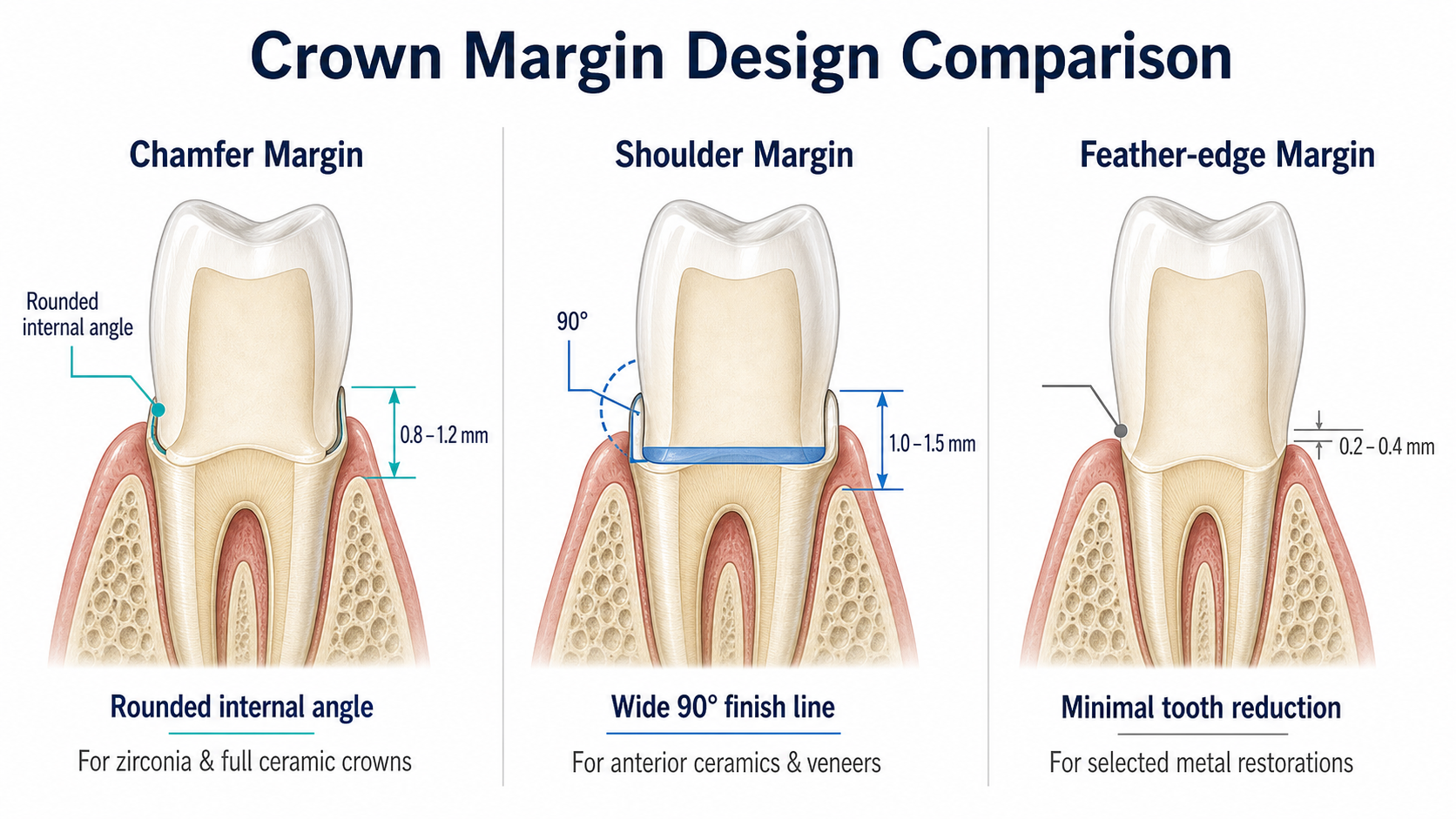
A chamfer margin is a rounded finish line with a curved transition between the axial wall and the crown edge. It is commonly used for zirconia, PFM and selected all-ceramic restorations when the preparation depth and material support are appropriate.
From a lab perspective, a well-defined chamfer can be easy to identify in CAD software because the margin creates a readable curve around the preparation. A very shallow chamfer can be more difficult because the finish line may fade into the axial wall or merge with scan noise.
The terms light chamfer and deep chamfer describe different depths and material-support situations. The lab should not assume the intended material thickness from the word chamfer alone; the prescription, material and scan must be reviewed together.
What Is a Shoulder Margin?
A shoulder margin provides a ledge for restorative material. It is often associated with esthetic ceramic restorations because it can create space for ceramic thickness, shade control and margin support when designed appropriately.
A rounded shoulder is generally easier for ceramic systems than a sharp internal angle because rounded internal transitions can reduce stress concentration and improve CAD/CAM machinability. A butt shoulder may provide a clear ledge, but overly sharp corners can create production and material risks. Shoulder width should match the specific material, crown position and case indication.
What Is a Feather-Edge or Knife-Edge Margin?
A feather-edge or knife-edge margin has a very thin finish line and minimal visible ledge. This type of margin may preserve more tooth structure in some clinical approaches, but it can be harder for the lab to scan, mark and manufacture predictably.
Some materials, systems or conservative clinical plans may permit selected thin margins, but the clinic should confirm the indication with the lab and follow the material manufacturer's instructions. In digital files, the finish line still needs to be visible enough for the technician to mark confidently.
A National Dental Practice-Based Research Network survey described chamfer, shoulder and knife-edge preparations as real options used by clinicians, while also showing that margin choices vary by crown type and practice factors. See the PMC article on single-unit crown preparation techniques for broader context.
Chamfer vs. Shoulder: What Is the Practical Difference?
|
Factor |
Chamfer Margin |
Shoulder Margin |
Feather-Edge / Knife-Edge |
|
Basic shape |
Rounded finish line with a curved transition. |
Flat ledge; usually safer when internal angles are rounded. |
Very thin finish line with minimal visible ledge. |
|
Material space |
Can support many crown materials when depth is adequate. |
Often provides clearer ceramic space for esthetic restorations. |
Material thickness can be harder to control. |
|
Digital scan visibility |
Usually readable when the line is continuous and not too shallow. |
Often visually clear when tissue and moisture are controlled. |
Can be difficult to detect if the finish line blends into the root surface. |
|
Margin thickness control |
Depends on depth and clarity. |
Can support more defined edge thickness when designed correctly. |
Thin edges may create design and milling limitations. |
|
Common restorations |
Zirconia, PFM, some all-ceramic cases depending on instructions. |
All-ceramic esthetic cases, PFM facial margins, selected zirconia cases. |
Selected systems or conservative clinical strategies only after lab confirmation. |
|
Potential risk |
Too shallow can create thin margins or unclear scan data. |
Sharp internal angles can concentrate stress; over-reduction may be invasive. |
Unclear digital margins and insufficient material support. |
This comparison table is not a universal clinical prescription. Final crown preparation depends on material system, tooth position, remaining tooth structure, esthetic demand, cementation method, occlusion and the manufacturer's instructions for the selected restoration.
Margin Design for Zirconia Crowns
Monolithic Zirconia
Monolithic zirconia is often used for posterior crowns and higher-load cases, but margin quality still matters. The lab needs a continuous finish line, enough material support and a preparation that avoids unnecessary sharp internal angles. The margin should allow the restoration edge to be designed without creating a thin, unsupported or unclear crown margin.
Zirconia systems have product-specific preparation and minimum thickness requirements. Ivoclar's IPS e.max Zirconia technical guide states that zirconia preparations should follow material guidelines and avoid sharp corners or edges, and it describes rounded shoulder and chamfer options within its preparation guidance. Clinics should check the relevant zirconia IFU rather than applying one generic rule to all zirconia crowns.Ivoclar zirconia technical guide.
Layered Zirconia
Layered zirconia requires space for both the zirconia framework and the veneering ceramic. In esthetic areas, margin design must support the framework while leaving enough ceramic space for contour, shade and translucency. If the preparation is too tight, the technician may have limited room for layering and final characterization.
The key point is that layered zirconia needs the margin, framework design and veneering space to work together.
Margin Design for E.max Crowns
E.max crowns are lithium disilicate ceramic restorations, so preparation design should support ceramic thickness, esthetics and the cementation or bonding plan. A rounded shoulder or suitable chamfer may be used depending on the indication and manufacturer's instructions, but the lab needs enough preparation space to avoid weak or overly thin margins.
E.max margin design should not be copied directly from a zirconia preparation without checking the case. Lithium disilicate and zirconia have different material behavior, translucency, bonding options and edge-support requirements. Ivoclar's IPS e.max CAD product information directs users to its instructions for use and dentist instructions for material-specific handling.
For a broader material comparison that does not focus only on margins, read Times Dental Lab's Zirconia vs. E.max guide.
Margin Design for PFM Crowns
PFM crowns require space for a metal coping and, where esthetics are needed, veneering porcelain. This is why margin design may differ between the facial and lingual surfaces. A facial shoulder may help provide porcelain space in visible areas, while a lingual chamfer may be used when the prescription calls for metal support or a metal margin.
If the facial margin does not provide enough room, the opaque layer and veneering porcelain can become difficult to manage esthetically. If the margin is unclear, the lab may not know where the metal edge, porcelain edge or collar design should terminate. The prescription should state whether the clinician wants a metal margin, porcelain margin or other PFM margin design.
For related material planning, see Times Dental Lab's article on PFM vs. Zirconia Crowns.
Why Clear Margins Matter in Digital Impressions
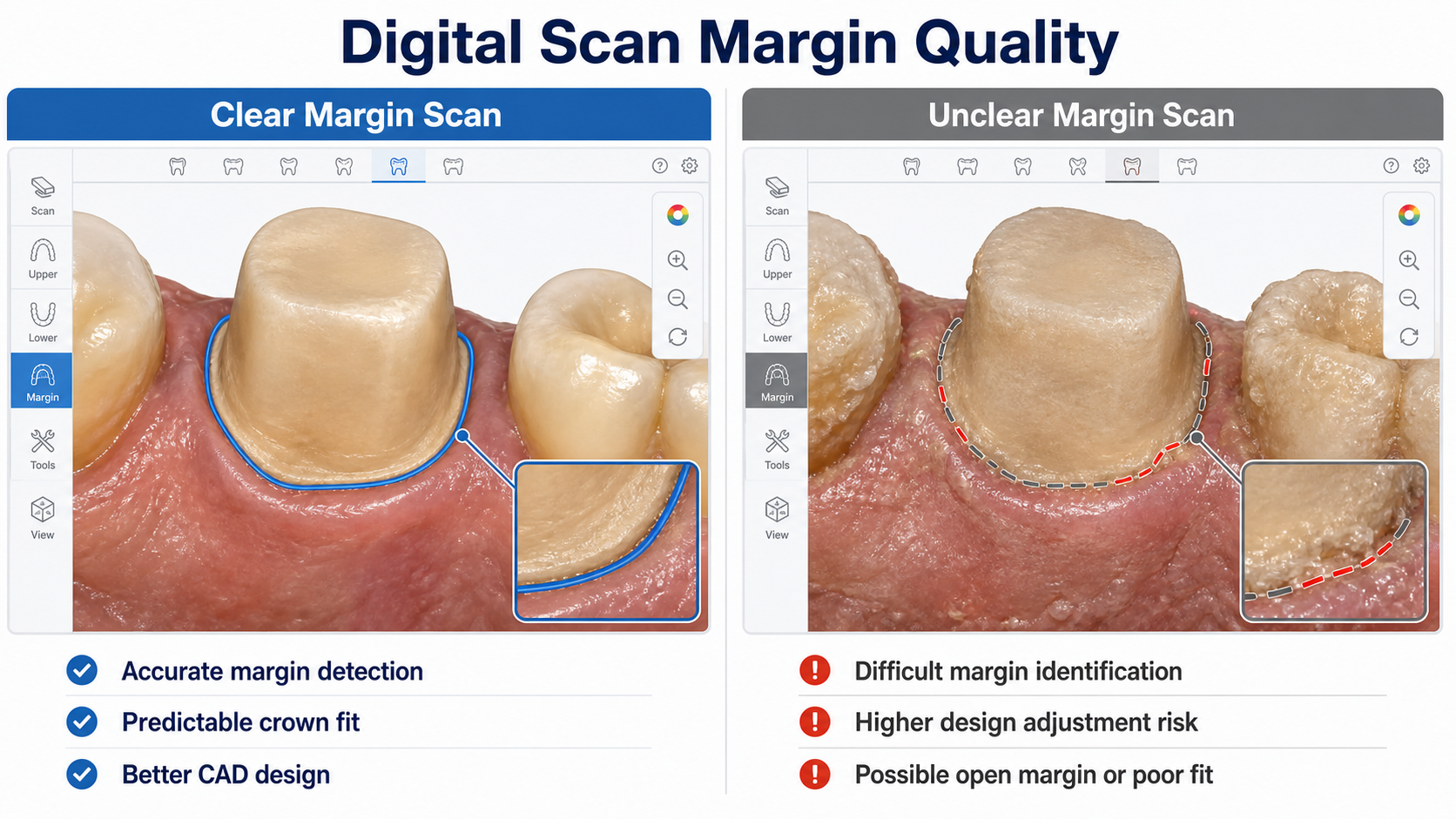
Clear margins matter in digital impressions because the CAD designer must convert the scan into a precise design boundary. A margin that looks understandable in the mouth may still be unclear in the scan if blood, saliva, retraction issues, soft tissue coverage or reflective surfaces interfere with data capture.
· The margin is covered by blood, saliva or soft tissue.
· The scan has missing data around the finish line.
· The margin line is discontinuous or blends into the axial wall.
· The preparation data merges with adjacent teeth or tissue.
· The scan resolution is not enough to show the finish line clearly.
· The technician cannot confirm the finish line from the STL file alone.
· The physical working model and intraoral scan do not match in the margin area.
What Times Dental Lab Checks Before Crown Design
Before crown design begins, Times Dental Lab checks whether the submitted scan, prescription and case information are complete enough for production. The review is practical: the team looks for the margin, space, material instructions and digital records that will affect fit and manufacturing.
|
Times Case Review Step |
What the Team Checks Before Crown Design |
|
1. Restoration and material |
Confirms whether the case is zirconia, E.max, PFM, layered zirconia, bridge, implant crown or another restoration. |
|
2. Margin continuity |
Checks whether the finish line is visible, continuous and readable in the scan or model. |
|
3. Occlusal and axial space |
Reviews available clearance for the prescribed material and restoration design. |
|
4. Adjacent and opposing data |
Checks contacts, opposing arch, bite record and scan alignment. |
|
5. Shade and stump shade |
Reviews shade photos, stump shade notes and esthetic requirements when relevant. |
|
6. Mark unclear areas |
Uses screenshots or case notes to identify areas where the margin cannot be confidently marked. |
|
7. Confirm before production |
Pauses design or manufacturing when missing information may affect fit, margin thickness or final restoration quality. |
This review step supports the same quality-control logic described in Times Dental Lab's Dental Lab Quality Control article: preventable uncertainty should be clarified before production, not discovered after the crown has already been made.
What Should a Clinic Send When a Margin Is Difficult to Read?
When a crown margin is difficult to read, the clinic should send additional information before asking the lab to guess the finish line. A short clarification before CAD design is usually better than a crown that needs major adjustment, remake or prolonged chairside correction.
· A corrected intraoral scan after tissue control and drying.
· Clear preparation photos showing the finish line from multiple angles.
· A screenshot with the intended margin marked by the clinic.
· A supplemental scan after soft tissue management if the original scan is covered.
· Material and restoration instructions, such as zirconia, E.max, PFM, layered zirconia or implant crown.
· Written confirmation if the case is urgent and the clinician wants the lab to proceed despite an unclear area.
FAQs
Is a chamfer or shoulder better for a zirconia crown?
Neither chamfer nor shoulder is automatically better for every zirconia crown. Zirconia crown margin design depends on the zirconia system, restoration type, material thickness, tooth position, occlusion and manufacturer's instructions. The margin must be clear, continuous and compatible with the prescribed material.
What margin is commonly considered for an E.max crown?
E.max crown preparation margins often involve a rounded shoulder or suitable chamfer depending on the indication and material instructions. The key requirement is enough ceramic support and a preparation design that follows the official E.max guidance for the selected restoration.
Can a dental lab design a crown when the margin is unclear?
A dental lab may be able to design a crown when part of the margin is unclear, but this increases risk. Times Dental Lab generally recommends confirming unclear areas before design or production because the finish line controls the final crown edge.
Why does the crown margin look clear clinically but unclear in the scan?
A clinically visible margin may become unclear in a digital scan because of soft tissue coverage, bleeding, saliva, reflective surfaces, scan angle, missing data or limited resolution. Additional preparation photos or a corrected scan can help the lab identify the finish line.
Is a feather-edge margin suitable for every zirconia system?
A feather-edge margin is not suitable for every zirconia system or every clinical case. Some systems may allow selected thin-margin indications, but the dentist should confirm the material manufacturer's instructions and communicate with the lab before submitting the case.
Should crown margin requirements be confirmed before submitting the case?
Yes. Crown margin requirements should be confirmed before case submission when the material, margin design, finish line visibility or scan quality is uncertain. Early confirmation helps the lab avoid incorrect margin marking and production delays.
Conclusion
Dental crown margin design is not about choosing one universal best margin. Chamfer, shoulder and feather-edge preparations each have different material, scanning and production implications. The most reliable approach is to match the margin, material and digital records before the case reaches CAD design.
A clear and continuous finish line helps the dental lab mark the design boundary, control material thickness and reduce avoidable uncertainty. When the margin is unclear, the clinic and lab should communicate before preparation decisions become production problems.